

Markets: The S&P 500 rose 1.3% in the week to Thursday’s close, at 7,720, the Nasdaq 0.9% and the equal-weight S&P 500 1.6%, while the Euro Stoxx 50 gained 2.3% to 6,207. The split came on Thursday, when the Nasdaq lost 1.4% on Alphabet’s results while the equal-weight index gained 1.2% with more than three in four S&P 500 members higher, and Nasdaq futures are about 2% lower this morning after Amazon and Intel. Last week we expected wide dispersion under a heavy index; the dispersion came, but the index held up better than we thought until the results.
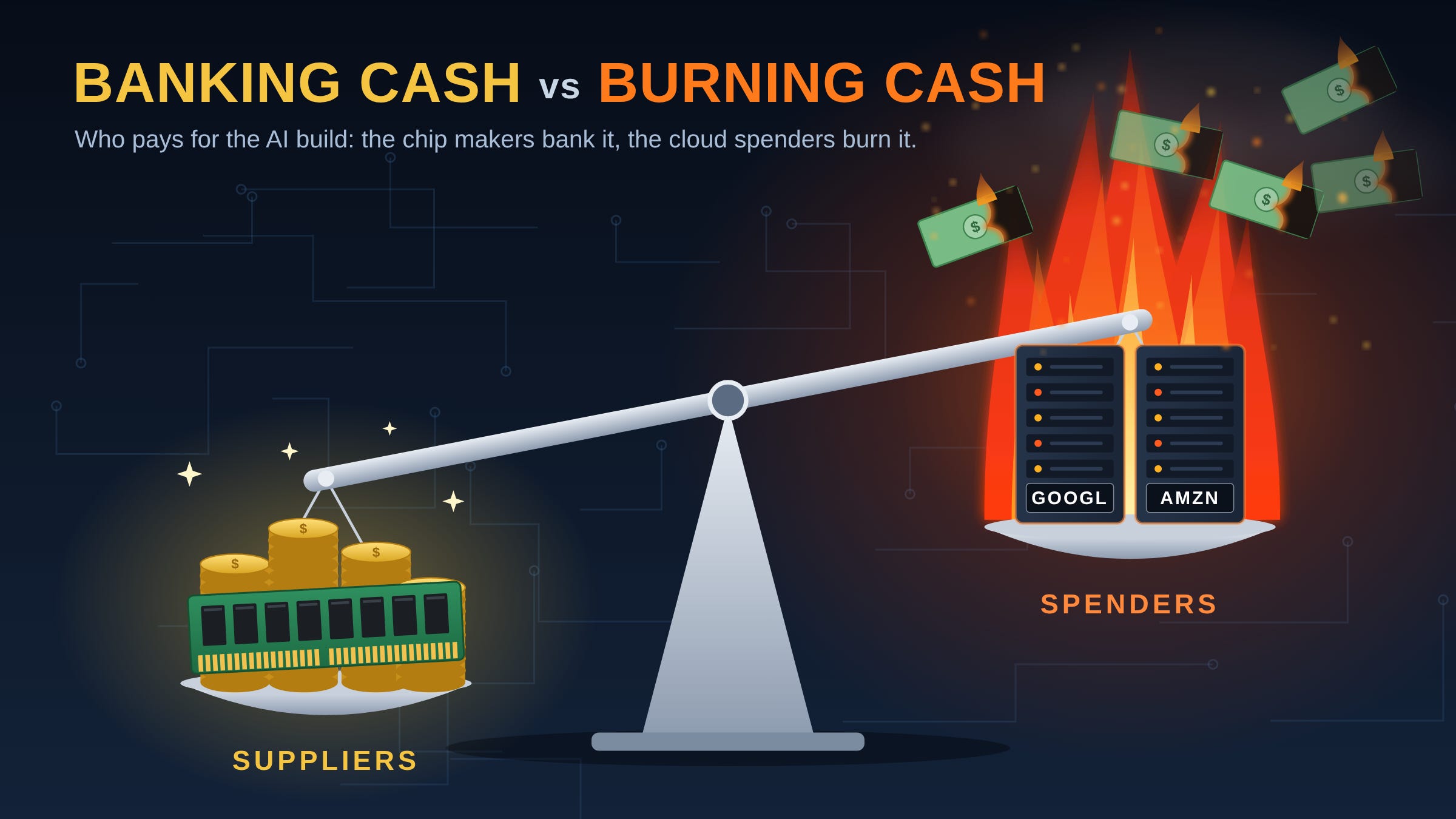
Cash flow: Azure grew 48%, Amazon’s cloud 39% and Alphabet’s cloud revenue more than doubled, yet Alphabet fell 12.6%, its worst day since its 2004 listing, and Amazon is about 7% lower before the open. The difference is how each spender pays for the build-out, and the market has started to price it company by company.
1.) Alphabet spent $51.4bn in the quarter, more than double a year earlier, leaving free cash flow at minus $9.1bn after minus $5.9bn in the second quarter, and pointed to about $300bn of capex in 2027. With search growing 12% against 15% expected, it lost close to $500bn of market value in a day.
2.) Amazon’s free cash flow over the past year is minus $42.4bn, capex is running at about $220bn this year and its fourth-quarter profit guide fell short, so the next leg of its build has to be paid for with outside money.
3.) Microsoft still covers its capex from cash and chose to borrow anyway: at least $25bn of bonds, its first US deal since 2017, drew about $115bn of orders.
4.) Meta sold $25bn of new shares at $625, the first part of a raise of up to $97.5bn, and closed below that price the next day, on a session when the chip index rose 3.6%.
Credit vs equity: The ICE BofA high-yield spread, the extra yield junk bonds pay over Treasuries, tightened to 314bp towards the end of the week from 340bp a week earlier, and investment-grade bond sales by the hyperscalers and data-centre developers have passed $313bn this year, about three times last year’s total. Lenders fund the build on ever better terms while shareholders mark down any spender that needs them, because bondholders are paid first and at a fixed rate, while shareholders own the cash burn and absorb every new share. The share supply is only starting: Meta’s raise includes $60bn of share sales from early 2027, and Anthropic, whose IPO filing showed $16.3bn of first-half revenue against $4.6bn in all of 2025, is reported to be targeting $100bn or more at a valuation of up to $2tn. The hardware sellers are now helping too: banks lent $63bn to a vehicle that buys Broadcom chips and leases them to Anthropic, with Broadcom backing their resale value. In our opinion suppliers financing customers deserves attention, even if today’s buyers are far richer than the telecom carriers of 2000.
Suppliers: SK hynix made about $62bn of operating profit in the third quarter, more than seven times a year earlier, at a margin close to 80%, and expects memory demand to exceed supply through 2030, with contracts from 14 customers already covering more than half of its 2027 and 2028 capacity. Samsung followed with about $80bn, almost nine times a year earlier. Intel’s miss is the same shortage seen from the buyer’s side: it guided fourth-quarter revenue to $15–16bn against about $17.1bn expected and fell 23% after hours, with CEO Lip-Bu Tan blaming “unprecedented memory supply tightness”. The cash in this cycle is piling up with the suppliers, which is why the chip index gained 6.9% in the week to Thursday, and in our view a customer’s cash-flow scare does not weaken whoever sells the scarcest input.
Korea & China: The KOSPI jumped 6.6% on Wednesday to 6,012 as foreigners bought about $860m after SK hynix’s results, then lost as much as 5% on Friday as the US cash-burn scare reached the memory makers, and still ended the week higher. EWY gained 7.0% in the week to Thursday and is up 66% this year, though 3.6% lower before the open. Last week we said the results would remind investors of the earnings; they did for two days, before Friday’s profit-taking on a customer scare. Korea stays on the winning side of the AI build because its chip makers generate cash and return it: SK hynix will hand back about $75bn this year, Samsung will set out a further $41–56bn in late January after about $22bn of dividends, and both trade on less than 4 times forward earnings. Korea´s third-quarter GDP grew 1.0% on the quarter, about half of it from chips, and we remain constructive. China is the mirror image: the CSI 300 touched a one-year low on Friday, heading for its largest monthly fall in a decade, while the PBoC keeps fixing the yuan, near 6.65 per dollar, weaker than expected, perhaps to slow its climb. Investors want to see Beijing spend on households before they come back, and so do we.
Funding: In the week to Wednesday 28 October, while companies were raising record sums, the Treasury’s cash account at the Fed rose $70bn to $1.016tn and bank reserves fell $74bn to $2.895tn. SOFR, the overnight rate on loans backed by Treasuries, has fixed above the 3.90% the Fed pays on reserves every day since 23 October, at 3.92–3.95%, a sign that cash is no longer plentiful. We were early on the Fed: we expected more bill buying before year-end, but it added only $3.7bn of bills that week, and Warsh said the balance-sheet review comes “probably early in the first quarter” and is “unlikely to have any material effect” now. Gold shows the squeeze, as we argued last week: it fell about 1.2% on Thursday although the dollar and yields fell and is testing $4,000, flat on the week, even as China’s gold imports through Hong Kong rose 28% in September, because funds sell what they can to raise cash. Global liquidity, central-bank money plus money supply in the four big economies, measured in dollars, grew 6.0% in the year to September against 7.4% in July, and close to 30% of it is currency translation. Relief before the new year now has to come from the Treasury spending down its cash.
Central banks: The Fed held at 3.75–4.00% on a 10–2 vote, with Governor Cook and Cleveland’s Hammack voting for a hike, the first time since 1992 that a governor and a regional president dissented together; Warsh said “monetary medicine is starting to work”, and a December hike is still 78% priced. Elsewhere the hawks set the tone: the Bank of Canada raised rates for the first time since 2023, to 2.50%, the ECB held at 2.50% after debating a hike, and the BoJ held at 1.25%, with one vote for a hike, while more than doubling its planned ETF sales to about $5.5bn a year. Only New Zealand’s central bank held back, skipping an almost fully priced hike ten days before an election. Oil is the common thread: Brent’s expiring December contract is about $116, up about 11% in October, after an attack on a tanker in the Strait of Hormuz. While Brent stays above $110 we expect hikes abroad to continue and a December Fed hike to stay priced, a mistake in our view.
Treasuries: The 10-year Treasury yield is 4.91% in Tokyo this morning, about 8bp lower on the week and 37bp lower in October, its largest monthly fall since December 2023. Yields rose on the Fed decision, the 30-year by 6bp to 5.36%, then fell through strong data, with third-quarter GDP growing 3.4% and September PCE inflation at 3.6%. Supply was absorbed less smoothly at the front. The Treasury sold $183bn of 2-, 5- and 7-year notes, and indirect bidders, the usual proxy for foreign demand, took 45.7% of the 2-year against a 58.3% six-auction average, before the 7-year cleared at the yield the market expected. The long end is calmer: holders offered back only $10.75bn of 20- to 30-year bonds for a $6bn buyback of older issues, against offers of 2.5 times the amount earlier in the month. Brazil showed what happens when investors lose faith in a fiscal path: after Lula’s re-election the Ibovespa fell 13.9% in a day and the Treasury cancelled two bond auctions. We expect Wednesday’s refunding, when the Treasury sets how much it borrows and in which maturities, to trim 20-year and longer issuance.
Risk: One half of our thesis was confirmed this week and the other was not. We have argued since mid-October that demand is clear in our opinion while demand for money (and its price) sets the direction, and last week we observing credit carefully: a high-yield spread back below 300bp would change our mind, more share sales with spreads above 350bp would confirm it. The share sales came in force, and of the four biggest spenders only one still funds its capex from cash, yet spreads tightened. We now think the cost of capital for AI is rising through shareholders rather than lenders, through dilution and lower multiples rather than defaults, and that it will keep doing so for months, because the 2027 spending plans we saw this week are bigger, not smaller. The bulls expect cash flow to turn once the new capacity earns; we agree for the suppliers, not for the cash-burning spenders. The test is the price of the next big deals, Anthropic’s listing first: if they clear easily, money is still abundant; if they need a discount, the squeeze moves into credit, and a spread back above 350bp would confirm it. Our preference for equal weight over AI hardware lost out to this week’s chip rally, and equal weight only drew level with the Nasdaq thanks to Thursday.
Next week: China’s official PMIs come out on Saturday, and on Monday Apple and Palantir report after the US close, with ISM manufacturing at 15:00. Tuesday brings the US midterm elections and the RBA (03:30), Wednesday the Treasury’s refunding (13:30), Thursday the Bank of England (12:00), with a hike almost fully priced, and Friday October payrolls (13:30).
Macro Derivs is general market commentary for information and education only. It is not investment advice or an investment recommendation, and it takes no account of any reader’s circumstances. Views are the author’s own and can change without notice. The author works in financial markets and may hold positions in the instruments discussed.