

Markets: The S&P 500 rose 2.5% to 7,562, with the Ndx up 3.6% and the equal-weight S&P 500 2.4%, while the SX5E added 3.5% to 6,387 and the Stoxx 600 closed at a record. The index hid a rough week of jumping front-end yields, a CEO leaving Nvidia and daily swings from +2.35% to −0.4%. Last week’s main call, that the global chip suppliers had been punished too hard, held up… our hope that October’s CPI would talk the Fed out of a December hike did not survive Tuesday.

The Fed: What drove the swings? Three things, in this order in our view.
1.) The Fed’s words and the front end. A third 0.3% core CPI print, Waller saying “a 50 basis point hike… should be considered” in December and Hammack asking for “smaller, more frequent hikes” took the 2-year yield up 37bp on the week to 4.88%. December is now fully priced, with about a 10% chance of 50bp. Thursday’s hit was broad, with the equal-weight index down 0.9% and the Russell 2000 1.7% against 0.35% for the S&P 500.
2.) Positioning. Monday’s 2.35% gain, the week’s biggest, came with the 2-year up 5bp: after a 2.7% fall the week before, the VIX dropped from 25.6 to 19.9 and Brent fell 5.5% when Trump called new Iran strikes “highly unlikely” (on Tuesday we put the rally down to a Senate vote on permitting, one cause among several). Wednesday’s 1.3% gain, with the bond market shut, came from CoreWeave’s results.
3.) Nvidia. A single-name shock rather than an index one: on Thursday it fell 4.3% as Huang resigned, but AMD and Broadcom rose 5–6% on bets they win share, so the money stayed inside the chip designers.
Friday does not fit neatly. PPI rose 0.3% against 0.4% expected, yet the 10-year touched 5.16% as Bowman said inflation pressures “have shown recent signs of broadening”, while the equity selling was in chips (SOX −3.4%, AMD −8.8% after a 30% run) and equal weight rose. The Fed set the direction for bonds, the dollar and gold all week, but the index’s big swings came from positioning and AI news. We still think the December hike is a mistake, and it is going to happen.
Bonds: The pressure sat at the front end, with the 10-year up 29bp to 5.15% and the 30-year only 22bp to 5.48%, and through Tuesday, the latest official data, all of the 10-year move was in real yields (the return after inflation) while breakevens (the inflation rate bonds price) edged lower… a Fed repricing, not an inflation scare. The 3-, 10- and 30-year auctions all tailed (cleared above the yield expected just before the sale) and foreign demand missed its average for an eighth sale in a row, yet the long end moved least, cushioned by the Treasury’s buybacks of older bonds.
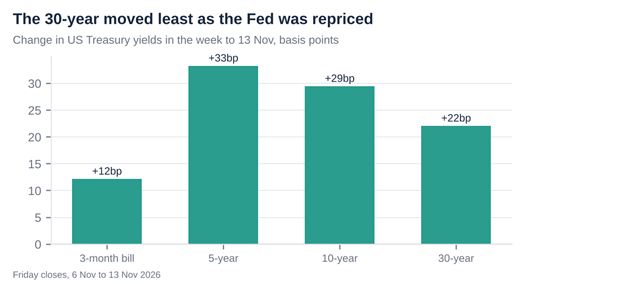
Chart 1: Change in US Treasury yields in the week to 13 November
Vol: The S&P 500 has realised 21.9% volatility over the past month, about 1.4% a day and close to the highest of the past year, yet a 1m ATM straddle prices a 0.99% daily move and the VIX, at 19.3, sits below realised. Options treated CPI, the auctions and CoreWeave as events that had passed, while crash protection stayed bid, with 1M SPX 90/100 skew still at around 11.4 vol points, the 96th percentile of the year.
VIX futures barely charge for a crowded calendar into the 9 December Fed meeting (19.6 for November, 19.75 for December), and implied correlation fell from 20.5 to 11.9 in four sessions while Nasdaq 100 vol sits in its 92nd percentile… the volatility is inside tech. Considering the auctions, the move in yields, the dollar and realised vol, we still think front vols underprice the potential for moves.
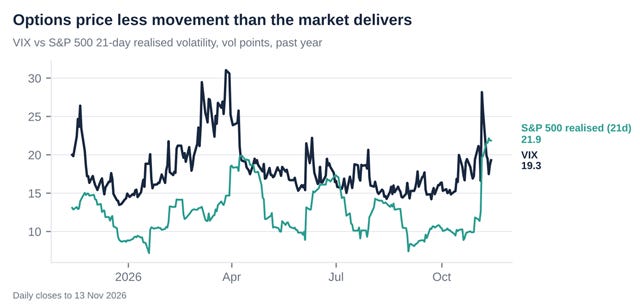
Chart 2: VIX against S&P 500 21-day realised volatility, past year
Nvidia: Nvidia fell 12.7% on the week to $162.85 after Huang resigned on Thursday. It traded down to $148.80 and closed Thursday 12% above that low, while about $1bn went into leveraged long Nvidia ETFs. At 13.5x forward earnings and 10x consensus for the year to January 2028, against about 25x for the platforms buying its chips, the market prices key-man risk and Washington, and Tuesday’s results will test demand. There will be plenty on moves next week and various Tech heavyweights (and shareholders) are asking the board to reinstate Jensen Huang.
The rest of the chain rallied around it, with the market actually pricing it as the timing shock without lost demand we argued for last week. The GPU and custom-chip designers ended flat as a group (16x), with AMD up 18.9% (35x) and Broadcom 18.2% (20x), memory gained 10% (3.4x) and chip-equipment makers 7% (21x) after Applied Materials guided above consensus for the quarter to January. The grid and electrical-equipment makers rose 6.5% (24x): orders are coming, and on Tuesday we called their monthly fall too harsh, BUT at 22–34x the price already pays for them while Korean memory trades under 3x, which is how both views hold.
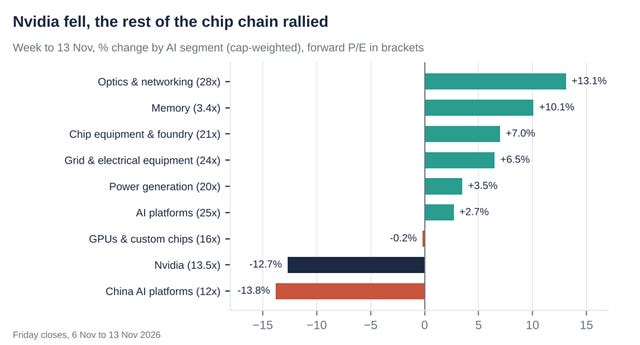
Chart 3: Weekly change by AI segment, with forward P/E
Credit: The Bloomberg US high-yield spread (the extra yield junk bonds pay over Treasuries) tightened 20bp on the week to 316bp while the neoclouds, which rent out computing power on borrowed money, fell. Nebius lost 16.8% on Thursday after raising its 2026 capex to $27bn and guiding revenue to the low end, and CoreWeave gave back about two-thirds of Wednesday’s 25% jump. Twice we tied wider spreads to an event (a hot core CPI, then a soft 30-year auction), both events came, and the spread tightened anyway.
In our opinion lenders read hikes into 200k jobless claims as a cost for leveraged borrowers rather than a default story, so our caution stays on the builders, not on credit as a whole, and we stay attentive to lagged effects. The builders are passing the bill on, CoreWeave to its customers through about $9bn of prepayments and Anthropic to equity investors through an IPO of up to $64bn.
Dollar & gold: DXY rose 1.1% to 103.4, a 19-month high, and the yen traded briefly beyond 160 per USD on Thursday without the intervention Tokyo has hinted at. Gold fell almost 5% to about $3,886 after a one-year low of $3,876, falling WITH the dollar and real yields. On Monday we wrote that an official buyer (the PBoC, 25.8 tonnes in October) was replacing the funds selling for cash… three days later it had not offset the jump in real yields. Gold is trading as a rate asset, and in our view it cannot credibly rally until the Fed shows it is comfortable being behind the curve, or the PBoC decisively prints.
Liquidity: In the week to Wednesday 11 November the Treasury drew its cash at the Fed (the TGA) down another $22bn to $914bn and the Fed’s balance sheet grew about $11bn, leaving bank reserves at $2.96tn, still below $3tn. Funding has gone back to calm, with SOFR (the overnight rate on Treasury-backed loans) at the Fed’s 3.90% reserve rate and 3-month bills about 6bp over expected policy rates, from 10bp a month ago. Global liquidity grew about 6.9% in the year to October, but China accounts for about 6.6 points of it, and outside China, at constant currencies, growth is about 2.2%, mostly bank lending rather than central-bank money, the more fragile kind when yields rise.
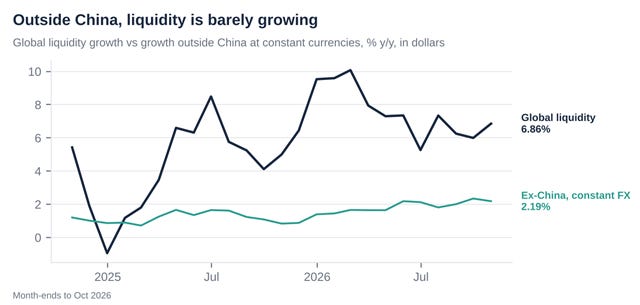
Chart 4: Global liquidity growth against growth outside China at constant currencies
Korea & China: The KOSPI rose 4.6% on the week as foreigners came back as net buyers of about $340m, after selling more than $7bn the week before, while local retail investors sold about $2.3bn. EWY gained 4.2% and is up 47% this year, with Samsung up 9.2% and SK hynix 7.4% as CoreWeave’s plan to spend about as much next year as this gave memory a first, if small, sign of 2027 volume. We remain of the view that this week’s equipment guidance does not read like the end of the cycle memory is priced for.
China went the other way. BABA fell about 14% and Tencent 8%, about $75bn of value between them, on reports that Washington may stop Chinese firms renting advanced chips in data centres abroad, leaving China’s AI platforms on about 12x forward earnings, while the CSI 300 slipped 0.8% on Thursday and the yuan held near 6.67 per USD. Next week’s summit is where chip access gets tested, but a lasting change still needs the PBoC to expand its balance sheet, and until then we expect China to lag.
Risk: The question this week was not whether AI demand holds but who pays for a Fed hiking into strength (in aggregate numbers only…hence the mistake). Our thesis is that demand is clear and the price of capital decides who pays, so far the builders rather than the global chip suppliers. This week added the front end as a second channel: hikes into a 6.5% PPI raise the cost of everything financed short from leveraged builders to small caps, while mortgages are already sitting ta historical highs (existing home sales are at their lowest since 2010). The bears would say a Fed tightening while options price less movement than the market delivers is how disorderly repricings start, and the bulls might say tighter junk spreads show the economy absorbing it. We think the indices can absorb the hikes (for now) there has been some repricing and we feel there plenty of negativity across many regions. We would worry more if the Fed continued with this hawkish, the equal weight began to fall with the neoclouds, or if Nvidia’s 2027 guide disappoints.
Next week: China’s October activity data arrive on Monday (02:00 London), with Warsh speaking at 17:00. Tuesday brings US October retail sales (13:30) and Nvidia’s results after the US close, and Wednesday UK CPI (07:00), the 20-year auction (18:00), the FOMC minutes (19:00) and Anthropic’s IPO pricing. Trump and Xi meet in Shenzhen on 18–19 November, Walmart reports on Thursday and Friday brings monthly options expiry.
Macro Derivs is general market commentary for information and education only. It is not investment advice or an investment recommendation, and it takes no account of any reader’s circumstances. Views are the author’s own and can change without notice. The author works in financial markets and may hold positions in the instruments discussed.