

Weekly Market Review
Week ending 31 July 2026 — The week the AI trade sorts itself
A very dense week. Four megacap earnings, record memory results out of Korea, a Fed meeting, oil above $91 with the Middle East conflict still live. By Friday morning almost every part of the framework we have been working with got tested, and mostly it came out reinforced. Quick reminder of that framework: AI models are commoditising — partly by deliberate Chinese industrial policy — so the value migrates to the two ends of the stack. Distribution platforms that can actually monetise the intelligence, and the physical layers (silicon, equipment, and above all electricity) that no open-source model can replicate.
1. The hyperscaler referendum: capex confirmed, monetisation now discriminates
With Alphabet last week and Microsoft, Meta, Amazon and Apple this week, the referendum on AI capex is complete. It passed. Every cloud is accelerating: Azure +43% (guiding ~45%), AWS +37% — its best growth in over four years — and combined hyperscaler capex now annualises well above $450bn. Meta even raised the floor of its 2026 range to $130–145bn. So demand for compute is not the question anymore. What changed is that the market stopped paying for spend as such: Microsoft (+15% post-earnings) and Amazon (+12%) were rewarded because the capex comes with revenue attached; Meta (−9%) was punished for spending against an EPS miss and shrinking free cash flow. This sorting is exactly what a commoditising model layer predicts. As one headline put it after Amazon’s print, ‘you don’t need the best model to win the AI race.’
2. Memory: listen to what the earnings calls actually said
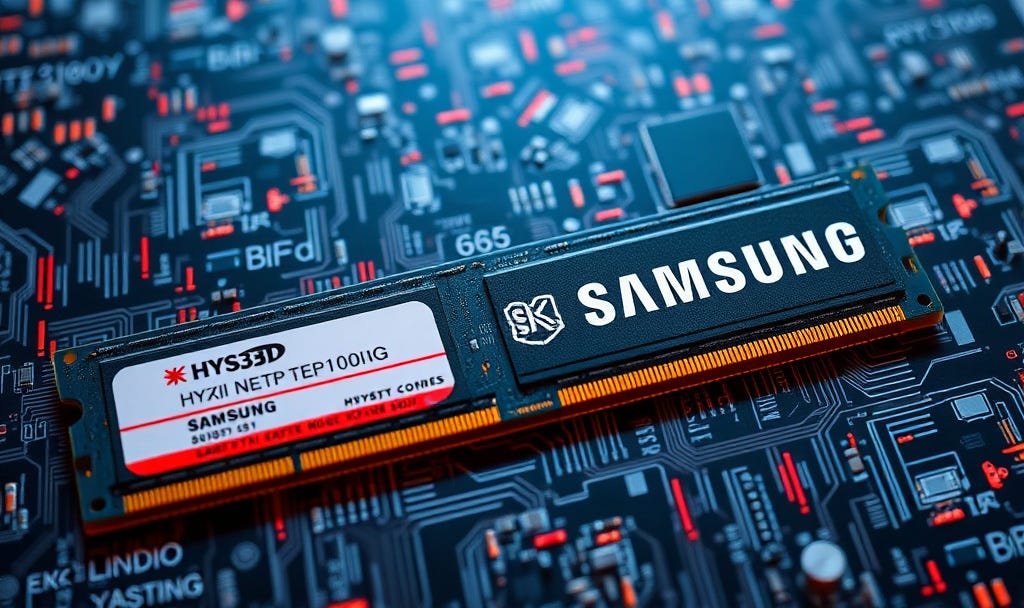
SK Hynix and Samsung posted numbers without precedent. Hynix earned more operating profit in one quarter (₩60.5tn, roughly $40bn, at a 76% operating margin) than in its best full year ever. Samsung’s ₩89.5tn was briefly the largest quarterly operating profit of any company on the planet — and 99.7% of it came from semiconductors. Both stocks initially fell. At around 3.0–3.5x factset consensus 2027 earnings (and below that on bbg consensus), the market is effectively pricing estimate cuts of 60% or more.
We think the most valuable information of the week was in the language on the calls, so it is worth quoting it properly. SK Hynix’s CEO called 2027 ‘the worst supply shortage in the memory industry’s history’, with HBM sold out into 2027 under long-term agreements. Samsung said the crunch extends ‘through 2028’ and that multiyear contracts could cover up to 70% of its planned HBM4 capacity. And then the buyer’s side, which is obviously an one: Apple — the largest component buyer in the world — described memory pricing as ‘a hundred-year flood’, admitted it is stockpiling inventory, raising retail prices, actively looking for alternative suppliers, and guided below expectations because of supply it simply cannot get. A seller claiming shortage is marketing. A buyer complaining about it is evidence.
This is why we think being long Korea still makes sense after the last day repricing which has reduced the Kospi drawdown to 27%. We think however that the above + headlines on Griffin buying Situational awareness assets + regulator intervention in leveraged products, margin-loan casualties could be signs that capitulation is close to be finished this week. Also we would like to point out the quality point matters here and gets missed: HBM is not a commodity you can copy quickly. It takes years of qualification with Nvidia, AMD and the hyperscalers, and packaging know-how that China’s CXMT does not have — CXMT competes in commodity DRAM, not in the high-bandwidth product where the profit pool sits. The contracted, hard-to-replace part of Korean memory earnings is exactly the part the market is refusing to pay for at 3x. We are aware of the other edge (record capex from all three incumbents is how every memory cycle has ended, and Apple raising prices is demand destruction at work), and Korean volatility is not for the faint-hearted, but risk/reward on this position sits on the buyside in our opinion.
3. Powering AI: expensive turbines, reasonably priced molecules
The physical build-out got its demand confirmation this week — all that hyperscaler capex has to plug into something — but within the power chain we think you have to split the trade in two, because the market is charging very different prices for the same theme.
On one side, the equipment makers: turbines, switchgear, cooling. The fundamentals are as good as fundamentals get — GE Vernova signing 20GW of orders in a quarter in which it shipped 3, gas-turbine slots effectively sold out towards 2030, transformer lead times of 3–4 years, and Eaton (the laggard we preferred) printing a record quarter with accelerating orders and re-rating 13% in two sessions. But even after this month’s washout — GE Vernova fell 9% on a guidance raise, Vertiv 17% on a revenue timing miss — much of the complex still trades north of 40–45x forward earnings. Great businesses, demanding prices. We stay observant, it feels perfection is still priced in those.
On the other side sit the midstreamers, which we think are the cheaper and cleaner way to own the same megatrend. Natural gas is the default fuel for the incremental U.S. electricity that all of this AI capex requires — it is what actually gets built when a hyperscaler needs power in three years, not ten. The beauty of the pipeline and liquefaction names (our favourites would be Kinder Morgan and Cheniere) is that they are volume businesses, not price bets: take-or-pay contracts and tolling fees on molecules moved, indifferent to whether Henry Hub is at $2.50 or $4 — indeed Cheniere’s economics improve when U.S. gas is cheap. Record gas production is meeting record gas demand, which is precisely the world where the toll roads earn. And the multiples are from a different planet than the equipment names: high-teens to low-twenties earnings multiples with real shareholder yields, for exposure to the same AI electricity story. Volume with reasonable valuations.
4. Valuations: an average multiple on extraordinary inputs
With 300 of 498 S&P companies now reported, second-quarter earnings growth is running at +57.5% year-over-year on +14.8% sales growth — figures with few precedents outside recession recoveries. Every sector is growing: Energy +136% (a war-inflated base effect we would not annualise), Consumer Discretionary +135%, Communications +119%, Technology +61%, and even the laggards (Real Estate, Utilities, Industrials) in double or near-double digits. Consensus 2026 index earnings have been revised from +15% growth in January to +27% and rising. Against that, the index at ~7,440 trades at roughly 20x forward twelve-month earnings and ~21.5x calendar-2026 estimates — near its five-year average. An average multiple on record margins, concentrated growth and estimates with strong upward momentum: fair if the AI cashflows keep arriving, fragile to any interruption. The dispersion is where we see the opportunity — the gas infrastructure and de-rated merchant power discussed above on one side, and the still-expensive confirmation trades on the other.
5. The macro overlay — and where we think it goes
None of this happened in calm conditions. Brent above $91 with the U.S.–Iran conflict unresolved, the Bank of Korea hiking into its own equity convulsions, ten-year Treasuries near 4.7%, and a Fed under new leadership that keeps talking hawkish. Two forward-looking views we would highlight however. First, on the conflict: we think everyone quietly knows the administration cannot let this extend — with midterms in November the political cost of $100+ oil is simply too high, and frankly if it were not for that expectation oil would already be trading higher. Coming out of it is not easy for the White House, and a good chunk of a resolution is already priced, but on a risk/reward basis we still favour betting on de-escalation into the autumn. Second, the dollar: the USD weakened notably on Thursday, and we read three things into it — the market starting to call the bluff on Chairman Warsh, who so far talks without acting; genuinely strong economic data out of Europe; and rumours of JPY intervention. Beyond the day’s move, we believe this administration wants a weaker dollar, and even if it stays rangebound near current levels we favour further weakening — with the positive knock-on that has for Chinese equities and for global risk assets in general. Put together: a market at average multiples on exceptional earnings, an inflationary war we expect to fade, and a softening dollar. We think it rewards staying invested in the right layers, while remaining disciplined on size as we come from a week with most asset classes trading at their range peak of volatility.
This document is provided for information purposes only and does not constitute investment advice, an offer, or a recommendation to buy or sell any security. Figures are drawn from company disclosures, Bloomberg and press reporting during the week and should be independently verified. Past performance is not indicative of future results.