

Weekly Market Analysis: Data Deluge Tests Rally Amid Tariff Tensions (Week Ending May 2, 2025)
The week ending May 2, 2025, proved to be a complex period for global financial markets. Building on the strong rebound seen in the preceding week, major equity indices faced significant headwinds as investors navigated a busy schedule of critical U.S. economic data releases and grappled with the persistent uncertainty surrounding U.S. trade policy. The previous week's rally (ending April 25th) had been driven by a perceived softer stance from the White House on China tariffs, reassurances regarding Fed Chair Jerome Powell's position, and robust earnings reports, particularly from the technology sector.
This optimism, however, set a high bar for further gains. The market entered the week facing a crucial test: could the positive momentum withstand scrutiny of incoming data on U.S. GDP growth, inflation (via the Core PCE Price Index), and the highly anticipated April Nonfarm Payrolls (NFP) report? Simultaneously, the unresolved nature of U.S. tariff policies continued to cast a long shadow, creating cross-currents that resulted in mixed performance across asset classes. Equities generally managed to extend gains, though with increased volatility, while economically sensitive commodities faced considerable pressure.
The week's dominant themes revolved around the market's interpretation of key economic indicators through the lens of potential Federal Reserve policy shifts, the ongoing economic and market impact of tariffs, the continued, though potentially narrowing, leadership of the technology sector, and adjustments in bond yields and commodity prices. Hard to point to one headline for the renewed positive mood strength, but in our opinion was a combination of reassurances that the US administration wouldn't let trade come to a standstill and probably from statements, including Commerce Secretary Howard Lutnick and Trade Representative Jamieson Greer, suggesting trade deals were close and tariffs might come down soon.
Financial Asset Performance Summary (Week Ending May 2, 2025)
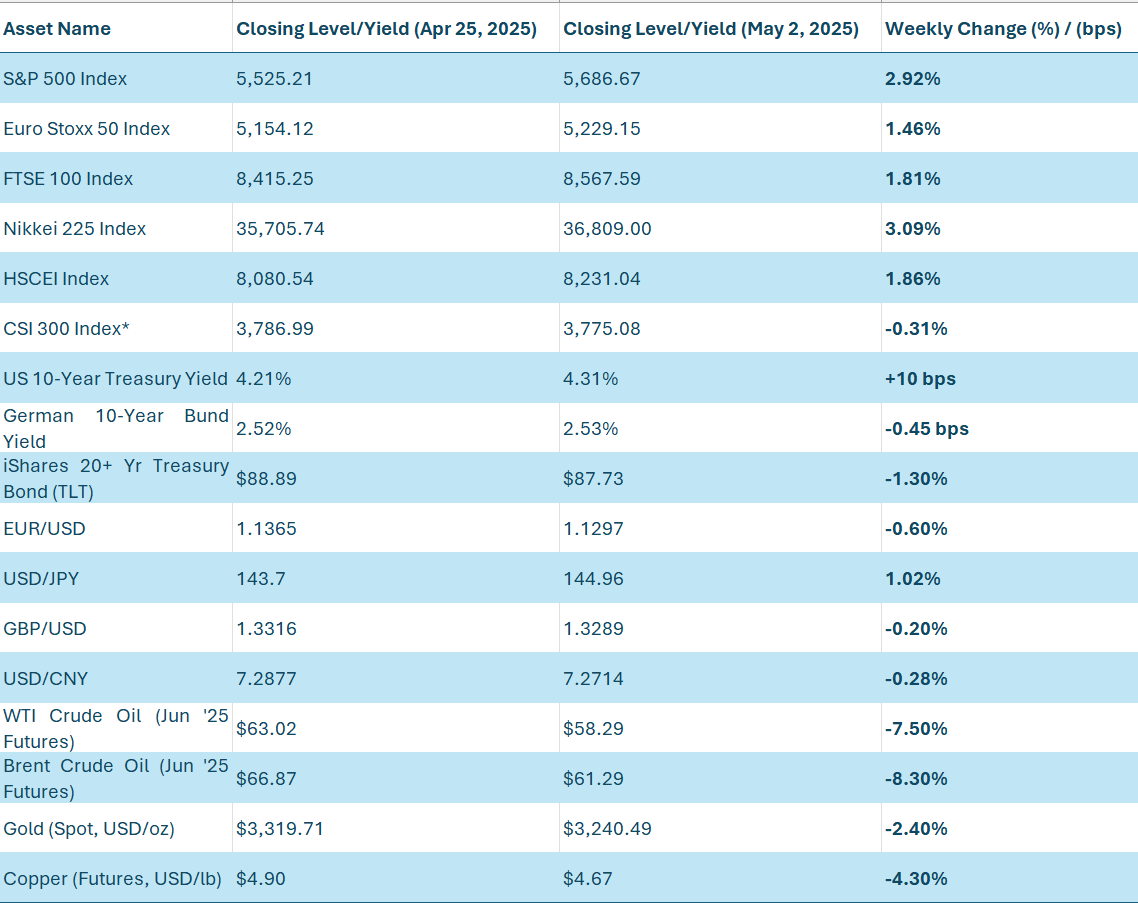
Key Market Drivers and Analysis (Week Ending May 2, 2025)
The week was heavily influenced by several interconnected factors:
The Tariff Tightrope and Trade Deal Hopes: Despite temporary relief from softer rhetoric the previous week, U.S. tariff policy remained a significant source of anxiety and economic friction. The administration's approach, seen by some as a "high-stakes economic gambit", injected uncertainty into global trade and investment. This uncertainty acted as a drag on market sentiment. However, statements from administration officials throughout the week suggesting trade deals were "close" and tariffs might come down provided boosts to equity markets. Some viewed these statements as deliberate attempts to influence the market and a signal that the administration would not allow trade to grind to a halt (we subscribe to this view). Concerns persisted regarding supply chain disruptions, cost increases for consumers and businesses, and potential layoffs in vulnerable sectors.
U.S. Economic Data Deluge: A heavy calendar of U.S. economic data releases tested the market's resilience.
Q1 GDP (Released April 30th): The report showed U.S. GDP contracted 0.3% in Q1. While better than some deeply negative forecasts, the mix required further analysis. The headline price deflator increased at a 3.7% pace in Q1 (vs. 2.3% in Q4), and core PCE excluding food and energy increased 3.5% (vs. 2.6% in Q4), both much higher than estimated. Real final sales to private domestic purchasers, however, a core measure of domestic strength, saw a solid increase (3% annualised). Imports were a massive drag (-4.8 ppts), offset only partially by inventories (+2.25 ppts) while Business fixed investment contributed significantly (+1.29 ppts), all these reflecting "tariffs front-running".
March Core PCE (Released April 30th): This key inflation measure reinforced the picture of price pressures receding, with the core PCE deflator printing @ 2.6% vs 2.8% Prior. While not yet at target level it does reinforce Trump’s statements inflation is ‘coming down’. This is our interpretation which is far from consensus which is saying inflation is still above target and fed needs to remain restrictive.
ISM Manufacturing PMI (April, Released May 1st): The index showed continued contraction at 48.7, slightly better than some of the lowest expectations. However, internal components painted a darker picture, with new orders and production in contraction. Supplier deliveries slowed (55.2), possibly due to tariff uncertainty, and prices increased, reaching the highest level since July 2022. This reinforced concerns about industrial weakness potentially linked to tariffs and slowing global demand.
Consumer Confidence (April, Released April 29th): Confidence fell to levels not seen since the onset of the Covid pandemic, driven by a sharp deterioration in the Expectations index, particularly for business conditions, employment prospects, and future income.
Labour Market Indicators: The ADP private employment report for April came in significantly below expectations at 62,000, the weakest since January 2021. Weekly initial jobless claims trended higher, and continuing claims saw a notable jump, though some increases might reflect seasonal noise around holidays. The most observed Nonfarm payrolls printed at 177k vs 288k prior unemployment rate @ 4.2%, labor force participation increasing a notch at a healthy 62.6% and Av Hourly earnings decreasing to 3.8% yoy. Overall a healthy report that definitely contributed to Friday’s rally.
Earnings Performance (Tech Leadership): Strong earnings reports, particularly from large-cap technology companies, provided crucial support to broader equity markets. Microsoft and Meta Platforms reported solid beats and reiterated substantial capital expenditure plans, especially for AI infrastructure, seen as a sign of confidence. Alphabet also reported strong results, particularly in Search and Cloud, and announced a dividend and buyback programme. This tech strength occurred despite challenges with forward guidance for many companies outside this narrow group, often attributed to tariff uncertainty. Apple's results, showed solid overall results but a decline in sales from China, causing its shares to fall. Amazon's operating income forecast also missed expectations.
Commodity Weakness: Economically sensitive commodities like crude oil and copper have experienced significant declines. WTI crude fell over 7.5% and Brent crude fell over 8.3%, attributed largely to fears of demand destruction stemming from tariff uncertainties and signs of economic slowdown. Trump wants oil at 50 and seems he is going to get it with new announcement yesterday Saturday that OPEC+ as agreed to accelerate oil production hikes for a second consecutive month, raising output in June by 411,000 barrels per day, despite falling prices and expectations of weaker demand. Saudi playing ball with trump.
Natural gas was the big winner posting a +23.6% weekly gain as the energy arbitrage (substitution of diesel trucks and machines by one’s working on much cheaper natural gas) manifested itself in full. Gold pulled back after its recent rally, indicating a pause in immediate safe-haven buying, though still trading at a high price above $3,200. This synchronized downturn in oil and other industrial metals like copper, iron ore, nickel... contrasted with equity gains, suggesting commodity markets were pricing in heightened risks to global growth driven by data and tariffs.
Outlook on Financial Markets Performance (Coming Days/Weeks/Months)
The week concluded with financial markets navigating a complex web of conflicting signals. While equity indices, particularly in the U.S. and Japan, posted further gains, extending the rally from late April, this occurred against a backdrop of increasing caution driven by the incoming U.S. economic data and the persistent uncertainty regarding U.S. trade tariffs.
Sustainability of the Equity Rally: We are of the view that market perception had turned excessively grim with narratives focused exclusively on negatives while ignoring positives like coming tax cuts, de-regulation and weaker USD. This said, in our opinion, 70% of the trade negotiations potential positiveness have already been priced in and any headlines from trump administration or China on the wrong direction on this front could quickly send equities down. We think however that Trump’s ‘put’ is there, Fed ‘put’ is there and neither of them wants to turn the economy into a sharp recession from which it is too hard to recover by Nov 2026 midterm elections. There have been big mistakes made by the Trump administration in the tariffs front and even them have been ‘surprised’ (to say the least) by the bonds, equities and FX reaction. Our view is that they have misjudged their hand on the tariffs front but not that they have become completely irrational (yet). A continuation of this dynamic very likely would translate into a loss of the house or senate on the midterms which would very likely mean a blockage of any new policies trump would like to enact last two years of mandate.
Continued Impact of Tariffs: Tariff uncertainty is expected to remain a significant overhang. The widespread view (which we share) that the high tariffs are "unsustainable" is based on the idea that the U.S. cannot sustain being cut off from Chinese imports. However, there's doubt they will go away easily, and even if lowered, they could still pose a significant problem. The ongoing debate and uncertainty surrounding tariffs will likely continue to cause volatility and weigh on sentiment, investment decisions, and consumption numbers.
Economic Slowdown and Policy Response: The U.S. economic data released during the week points towards a potentially slowing economy, highlighted by the Q1 GDP mix, ISM manufacturing contraction, falling consumer confidence, and stress signals from the housing market like weakest March sales since 2008 and high mortgage refi rejection rates. The Federal Reserve's stance remains cautious, emphasizing the need to see more clarity on inflation and economic activity although our interpretation is they are already turning to the easing camp. Market expectations for rate cuts were already significant heading into the week, and further weak data could intensify these bets. We are of the view that a mild ‘self-induced’ recession that causes the Fed to get behind risk assets could still be positive for stocks.
Outlook for Gold and Commodities: The sharp decline in oil suggests 1) it’s an oversupplied market. 2) that commodity markets are actively pricing in heightened risks to global growth and industrial demand due to tariffs and economic weakness. This pressure on economically sensitive commodities may continue if global growth concerns persist. For gold, despite the weekly pullback, we maintain a strong bullish outlook. Our view is that gold has undergone a significant "breakout" and is fundamentally underpriced and under owned by both central banks and private investors given the level of ‘real’ inflation and mostly eroded geopolitical trust. We think that gold prices are heading significantly higher after a consolidation phase that can take it to 3000-3100. Our target is around $3,600 ahead of a big equity correction/bear market perhaps one year down the line that will bring the metal down with it. Gold mining stocks are in our opinion significantly undervalued relative to the current and projected gold price with cheap energy prices (their main cost) and weakening USD adding to the tailwinds.
In summary, while equity markets saw gains driven by tech earnings and hopes for trade de-escalation, the underlying economic data, commodity price action, and lingering tariff uncertainty painted a more cautious picture, leading many to view the rally with skepticism regarding its sustainability. The outlook appears heavily dependent on the trajectory of U.S. trade policy and the Federal Reserve's reaction to incoming economic data, particularly inflation and the labour market. We are of the view that U.S trade policy trajectory will be positive, Federal reserve will be accommodative (as will be the PBOC whose target is to weaking the yuan vs real assets) and investor’s skepticism will lay the ground for a strong equity rally during the summer. We believe markets are now just focused on the ‘recession’ and ‘tariffs’ words. We believe however that equity markets can rally in mild recessions (and more if they are self-induced and fixable) when Central banks are behind, and we think that even if the move clearly won’t happen in straight line with some choppiness expected ahead, we have a bullish outlook medium term.