

This week ending May 9, 2025, was marked by a cautious sentiment across global financial markets, largely influenced by anticipation surrounding international trade negotiations, particularly between the U.S. and China. While some positive developments, such as a newly announced trade agreement framework between the U.S. and the U.K., offered temporary lifts, major U.S. equity indices generally experienced slight pullbacks as investors logically adopted a "wait-and-see" approach ahead of more definitive outcomes from the high-stakes U.S.-China discussions in Switzerland this weekend.
Another significant factor shaping market sentiment was the Federal Reserve's decision to maintain its current monetary policy stance. The Fed acknowledged heightened economic uncertainties linked to ongoing trade disputes, which tempered expectations for imminent interest rate cuts. Economic activity continued to expand at a solid pace, but the Fed warned about potential stagflation risks, including higher unemployment and higher inflation. While leaving their policy rate unchanged, they noted risks to both sides of its dual mandate. Powell, in his press conference, highlighted the strength of current economic data, including a broadly balanced labour market, but cautioned on risks from tariffs, calling economic uncertainty "extremely elevated".
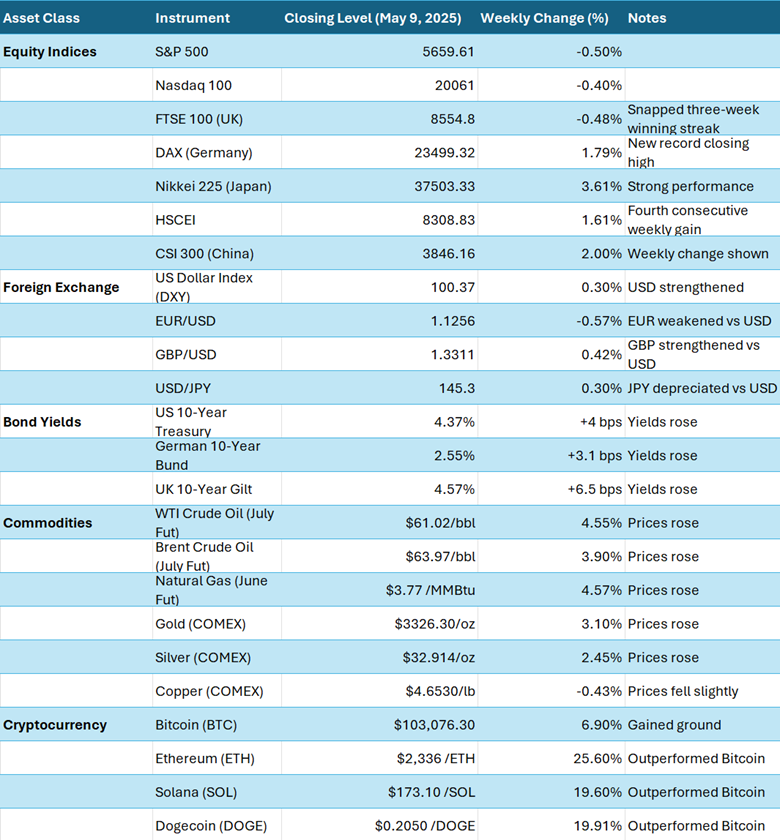
In equity markets, major U.S. indices closed the week with modest losses: the S&P 500 declined by approximately -0.50%, the Nasdaq Composite showed a weekly loss of -0.40%. Small-cap stocks, represented by the Russell 2000, performed slightly better, ending the week nearly flat with a -0.02% decline. Despite the slight indeces decline, market breadth improved, reaching one-month highs.
European equity markets presented a mixed picture. The FTSE 100 (UK) declined by -0.48%, snapping a three-week winning streak, although it rose on Friday lifted by trade optimism. The German DAX stood out with a strong performance, surging +1.5% for the week to achieve a new record closing high, marking its fourth consecutive week of gains. The DAX became the first major European gauge to surpass its March peak, recouping declines sparked by earlier trade war concerns.
Asian markets generally concluded the week higher, buoyed by optimism surrounding U.S.-China trade talks and specific regional stimulus measures. The Nikkei 225 (Japan) surged by +3.61%, attributed to broader trade optimism and a weaker Japanese Yen. The Hang Seng Index (Hong Kong) climbed +1.61%, its fourth consecutive weekly gain, driven by Beijing's stimulus and easing trade tensions. China announced a broad package of support for its economy, including lowering the PBOC’s 7-day repo rate and the reserve requirement ratio to release liquidity.
In currency markets, the U.S. dollar found support, with the US Dollar Index (DXY) closing the week up +0.30%. Government bond yields saw varied movements across major economies, generally rising in major developed markets. US 10-Year Treasury yields rose by +4 bps to 4.37%. German and UK bond yields also increased.
The cryptocurrency market displayed notable strength. Overall capitalization surged, with several altcoins significantly outperforming Bitcoin. Bitcoin itself made steady gains, rising +6.90% for the week to close at $103,076.3. Ethereum (ETH) rose +25.60%, Solana (SOL) rose +19.60%, and Dogecoin (DOGE) rose +19.91%.
In commodities, oil and gold found support. Gold rose by +3.10% for the week, with Spot gold trading around $3,324.98 per ounce on Friday close. Silver also increased by +2.45%. Crude oil prices experienced a notable rebound towards the end of the week, with Brent futures closing at $63.2/bbl (+3.4%) and WTI at $60.24/bbl (+3.7%) on Thursday, although Brent and WTI had slid earlier in the week following an OPEC+ output increase agreement. Copper experienced a slight decline of -0.43%.
Key Performance Table: Financial Markets Weekly Snapshot (Week Ending May 9, 2025)
The performance of individual stocks was mixed, but earnings reports drove significant moves for some companies. Insulet surged +21% following strong results, Microchip Technology jumped +12.6% on a better outlook, and Lyft shares soared nearly +30% after beating estimates and boosting buybacks. Disney and Boeing were also noted as having strong moves after being heavily discounted ahead of earnings. On the downside, Akamai Technologies declined nearly -11% and Expedia Group shares tumbled more than -7% after disappointing results. Lastly, it was a bad week for Google despite good earnings reported 2 weeks ago. More on that below.
Outlook on Financial Markets in the Coming Days/Weeks/Months
Looking ahead, the immediate direction for global markets is expected to be heavily influenced by the outcome and interpretation of the U.S.-China trade talks scheduled over the weekend with any significant breakthroughs or breakdowns having the ability to introduce considerable volatility. The market had previously responded positively to tariff negotiation headlines but is now confronting the reality that average effective tariff rates on most countries' U.S. exports may be the highest in decades. News of trade talks between Bessent, Greer, and Lutnick with China's Vice Premier He Lifeng in Switzerland lifted equity futures after the close earlier in the week, but details are sparse, and the process is likely to be drawn out. President Trump denied the prospect of lowering tariffs on China to kick-start negotiations but announced plans to simplify restrictions on AI chip exports. At the same time, it seems the European Union is preparing potential countermeasures if U.S. trade talks are unsuccessful, targeting industries like aircraft and autos. We believe that while businesses are on hold waiting for clarity, trade deal announcements in the coming weeks could surprise markets and force buyers who sold at the wrong time to chase gains.
Medium term, the Federal Reserve's future policy path remains a critical factor. While the Fed maintained rates, their acknowledgement of risks and the statement that they are "going to have to see how this thing evolves" leaves the door open for potential action depending on incoming data. Economic data such as non-manufacturing PMI in expansion and lower jobless claims suggest some resilience, but project delay mentions are picking up. Earnings and guidance have been seen as strong, giving the impression the economy is more resilient than most feared. This said, we are still of the view that the Fed's recent stance is too hawkish, potentially leading to a delayed negative reaction in the stock market at the end of summer if they continue course. We still believe, however, they will become more accommodative soon. Also, we believe the bond market and dollar reaction ‘make sense’ for a hawkish Fed, although we think both those will turn in the coming months. Lastly gold continues fighting due consolidation showing the same strength, resilience and correlation-less from the last couple of years. We still believe it has a big room to rally before year end (3600-3700) with good potential to go through those levels.
When looking at the liquidity framework, we wanted to highlight our view that financial crises are fundamentally debt refinancing crises caused by a lack of liquidity relative to over accumulated debt. We subscribe to the idea that the debt to liquidity ratio is an important indicator as Ray Dalio and other commentators point out, with high levels historically preceding crises. While we consider current liquidity conditions could be described as "not too bad," with US government drawing down the Treasury General Account and China injecting a significant amount of liquidity in what seems like a deliberate devaluation of the Chinese yuan going on in the background, the picture looks different for Q3 and Q4 this year. Reverse Repo facility that has been an important source of liquidity for the last couple of years, is exhausted now, and refinancing needs in late 2025 through 2028 are intense. Bonds volatility that determines haircut on collaterals posted are not helping either. Let’s see when we get there but together with economic slowdowns are the backbone of our view about bonds bid, weaker USD and fed turning on second half of this year. Very short term however, configuration we see it as positive for risk assets.
On the stock market specifically, we have been bullish for the last couple of years, and we continue to be so in what we think is the last strong leg ahead of a big correction. Within our favorite sectors are Semis/AI related stocks, industrials and financials. In our opinion, sell off from the highs shouldn’t only be attributed to tariffs. The other 2 factors we think had significant weight were seasonality and DeepSeek appearance partially puncturing US-centric AI bubble. These sectors, which were hit hard in the recent correction, are coming back fastest and we do not see the positive outlook changing anytime soon. Two months is a long time nowadays in the AI world and since that DeepSeek moment, many important evolutions have happened, which in our opinion are just laying the ground for a renewed rally in this sector. We believe the market will push higher, not in straight line, with a few percent pullback that bears hoping for a retest might interpret incorrectly, before the market "rips higher". The correction we have just had, feels a bit to us like the 2018 Trump trade war one (20% correction resolved in 4 months) or the 2011 European Debt crisis one (20% correction took 8 months to resolve). The rally in the market, coupled with improving earnings guidance and resilient consumer spending (people still have jobs and are spending), supports a potentially positive outlook short term to us, and its extend will depend on if/when the Fed will turn. We believe medium term, international equities will potentially outperform the US (due to easier financial conditions/money printing abroad) but short-term US will potentially lead this rally back. Lastly, sentiment indicators suggest to us people are still skeptical or on the fence despite the recent rebound with institutions having been max sellers at the bottom of the correction.
We would like to take the opportunity this week to write a few lines on Google as even if it’s not Macro as per se, it underlines the most important crosscurrents, currently, in the AI ecosystem. Besides it happens to be one of the favorite stocks for this writing 😊. Will summarize in a few bullet points as we see developments:
Eddie Cue, who has been with Apple for 35 years, reportedly stated that Apple's search volume went down for the first time in 20 years, attributing it to people using AI search tools like ChatGPT and Perplexity. Reporting of this statement, caused a 100B drop in Google’s mkt cap despite Company responding they continue to see overall queries growth, including from Apple devices and platforms
We agree with some commentators that the ‘search click repeat’ paradigm is over and there will be a new model for human-computer interaction for information and services. We think however, that transitioning for Google from the current search interface to a chat interface, has to happen in a gradual phase. With search ad revenue still bringing 200B and cost to serve AI queries still in the ‘order of magnitude higher’ doesn’t seem to make sense to make this transition overnight.
We think Google is obviously aware of this and are trying to get the transitioning timing just right. We see crucial the involvement of founders Larry Page and Sergey Brin, with Sergey apparently actively engaged and working on the Gemini app, which its new deep research release is considered by most experts as the leader in the field. On our side, we are no experts and we haven’t tested thoroughly the competitors, but we are users of it and think it’s pretty impressive.
We believe Google has other very strong business like Waymo, Cloud, Cloud Apps and especially YouTube. We think this will give them a data advantage, especially in the ‘deep integration’ into people’s lives.
We believe there is little doubt current Google’s near 99% search share is starting to decline and has a good amount to drop before it stabilizes. At the same time, we think increased functionality of AI will drive search queries up significantly making the size of the pie of the Pie a lot bigger. We think Google will be more valuable than today with 70% share of the new bigger Pie.
Seems Google is recognized by most as the leader on the supercomputer front (in case topic resurfaces in coming months)
Of the Mag 7 group, it’s the company that currently operates the most monopolistic business, it’s at the forefront of the next ‘biggest’ things and trades on a lower PE. Therefore, we think a good chunk of the monopoly loss on search has already been priced in.
The biggest risk of course is that Google’s share of the new search market stabilizes at too low levels. We think it will still be significant enough for company to increase value from here, hence our bullish view on it. However, should it stabilized more in the 15-30% area because of strong performance of Chat GPT or new Chinese appearances, that would be very bearish for the stock.
In summary, while the immediate future for markets is tied to the outcome of ongoing trade negotiations and the Fed's data-dependent stance, in the very short term, the underlying economic resilience and positive earnings trends could support further market gains. The early April dip was seen as a significant buying opportunity, and we view the current skepticism as a potential setup for further upside, particularly for stocks that have lagged the dominant market leaders. The broader liquidity picture, driven by debt dynamics, suggests that central banks may eventually be compelled to ease, which could provide a tailwind for asset prices later in the year, with gold and Bitcoin potentially benefiting over the medium term. Short-term volatility seems unequivocally on a lower trajectory with most term structures across asset classes flattening or even turning upward sloping which if confirmed post this weekend meetings, should also be supportive of risk assets.