

Weekly Wrap · Prices as of Friday close, 20 Nov 2026 (news to Sunday 22 Nov, 09:00 London)
In short
→ The S&P 500 lost 8.6%, its worst week since April 2025, as Fed officials floated a half-point hike into falling energy prices.
→ Bonds disagreed: futures took 30bp out of the September 2027 policy rate, 20bp of it on Friday.
→ Options repriced the next two months and the downside, not the long run: stress, not a new normal.
→ The turn needs the Fed to bend first. Williams on Monday and PCE on Wednesday are the tests.
Markets
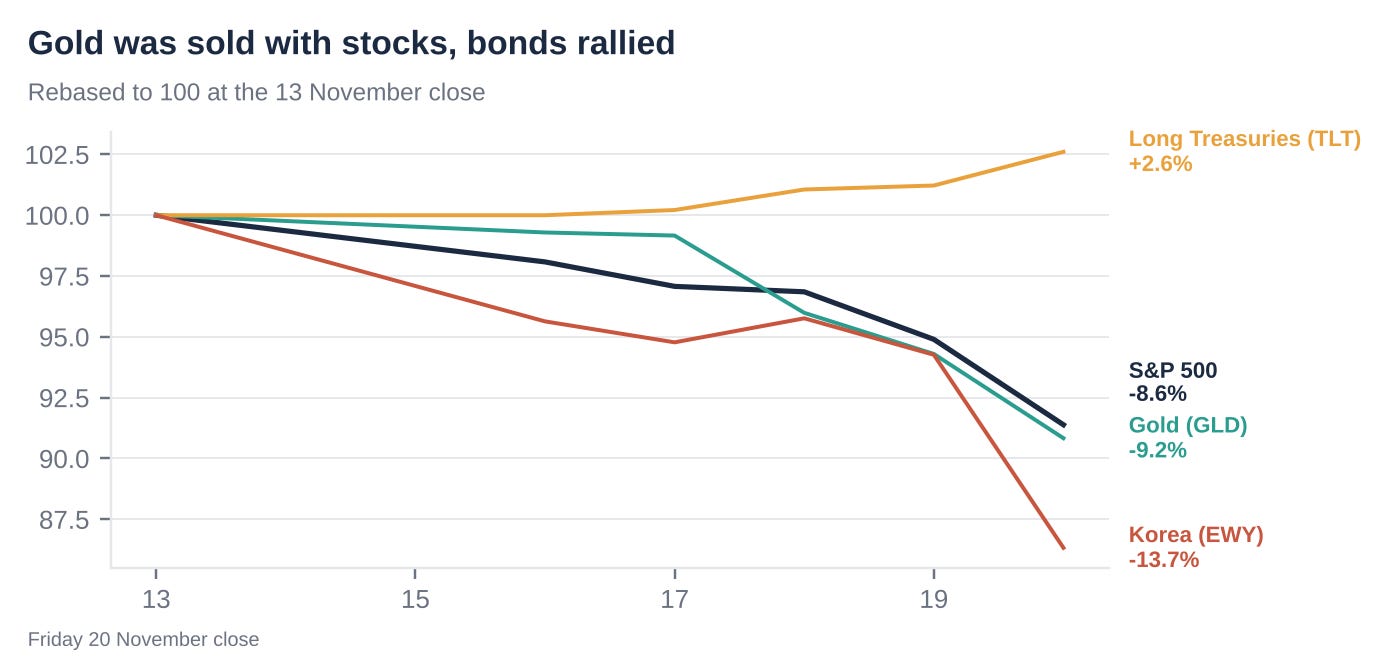
The S&P 500 fell 8.6% to 6,910, its worst week since April 2025, with seven straight daily losses for the first time since February 2020, and it now sits 11.6% below its 6 October record. The NDX lost 10.5%, the equal-weight S&P 500 6.2% and the SX5E 6.0% to 6,002, while EWY dropped 13.7% and gold 8.9%.
Friday did most of the damage, with the S&P 500 down 3.7% and Nvidia 14% on the day the Fed’s hawks spoke loudest. On Friday morning we wrote that the indices could absorb the hikes (for now). By the close they had not, and the bond market told us why.
The Fed
There was plenty of AI news this week, but what changed was the Fed’s tone, and it changed in the wrong direction for a slowing economy with falling energy prices.
1.) The escalation. On Tuesday Musalem said the economy will likely need “several interest rate increases before the spring of 2027” and Hammack asked for a hike at every meeting. On Wednesday Waller went further on television: “You have to go 50 in December to put it in place and get it done”, adding that the Fed “might need to shock people” out of thinking 3% inflation is normal. The October minutes, out the same day, showed almost every official expecting more hikes and two saying 50bp “could be necessary” if the data disappointed. By Friday Paulson was open to back-to-back hikes and Cook, speaking in Santiago, warned that “waiting longer to implement rate increases risks getting behind the curve”.
2.) The economy they are hiking into. The Philly Fed’s factory index fell to 6.3 from 20.9, continuing jobless claims rose 70k to 1.76m and pending home sales hit a record low. Brent is down 15% in a month to $92.57, diesel refining margins are about a third below their September peak, and the 10-year breakeven (the inflation rate bonds price) has fallen 20bp in a month to 2.16%.
The hawks have an argument, with prices paid jumping and core CPI at 0.3% three months running. But a half-point hike as energy rolls over is a policy for the last six months, not the next six, and the shock Waller wanted landed on the S&P 500 rather than on inflation expectations.
3.) Treasury pushed back. Bessent called this an “energy supply shock” last Friday, and on Friday asked the Fed not to “embrace a big interest rate hike as some Fed governors are doing”, noting that the governor now asking for 50bp wanted a cut of the same size within the past year. “I would encourage the Fed to look forward, not backwards.”
Waller’s proposal also corners Warsh, chair since May, who has dropped forward guidance: two smaller hikes only match one big one if the Fed signals the second. We have called the December hike a mistake for weeks. This week we were proven right, unfortunately, and the bill went to equities first.
Bonds
The bond market answered the hawks by pricing the reversal. The 2-year yield fell 19.5bp to 4.65%, the 10-year 19bp to 4.94% and the 30-year 14bp to 5.33%, so the squeeze at the front end has started to unwind.
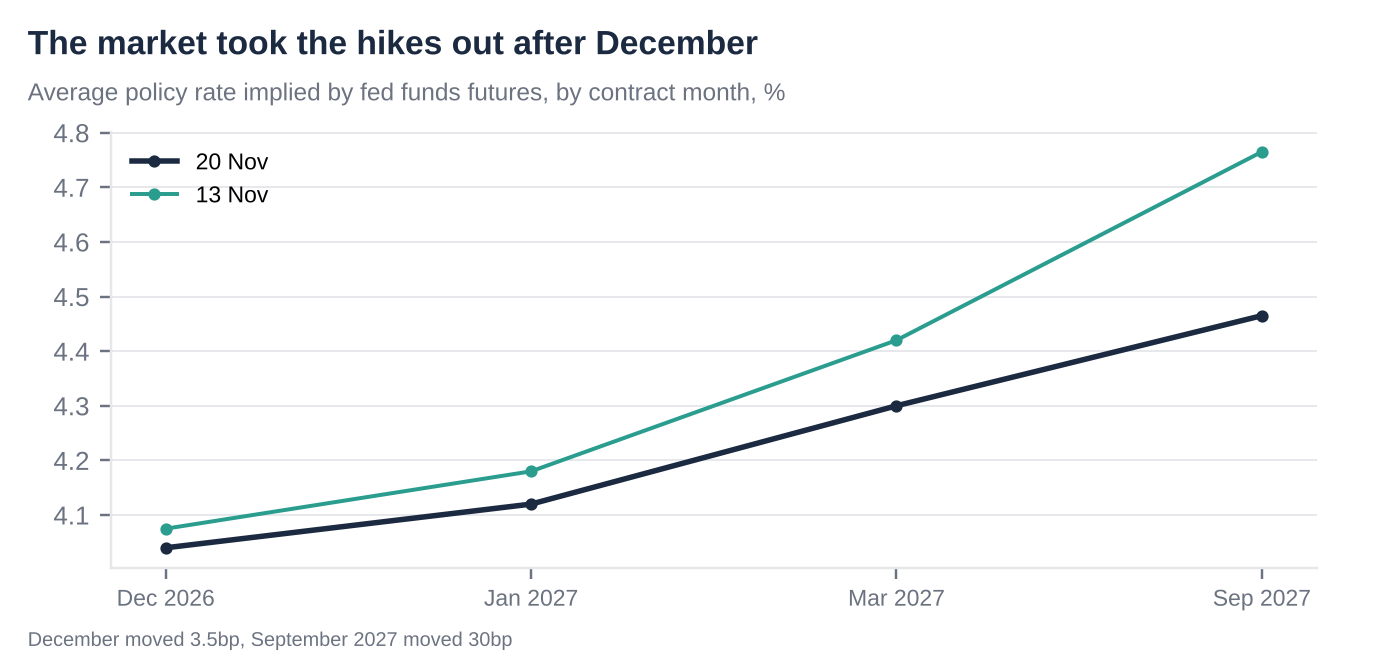
Fed funds futures (contracts that settle on the average policy rate of a given month) took 3.5bp out of December, 12bp out of March and 30bp out of September 2027, 20bp of it on Friday as Paulson and Cook spoke. December is still a hike. What the market no longer believes is the string of hikes after it.
Real yields (the return after inflation) fell 11bp on the week to 2.78%, after Thursday’s 10-year TIPS sale (inflation-protected Treasuries) cleared at 2.90%, the highest at auction since 2002, with foreign demand at 69% against a 64% average. Wednesday’s 20-year cleared right on the expected yield.
Holders are not dumping the long end either. The Treasury offered to buy back up to $6bn of old 20–30-year bonds and found sellers for only $4.6bn, accepting $1.2bn, and a 7–10-year buyback took just $254m of a $4bn maximum.
Liquidity
The money behind the market did not help. In the week to Wednesday the Fed’s balance sheet shrank $17bn, bank reserves sit around $3.0tn and the overnight reverse repo (where money funds used to park spare cash) is empty, so new Treasury bills are paid for out of reserves, with SOFR (the overnight funding rate) 1bp over what the Fed pays on reserves.
Into that the market had to absorb about $107bn of Anthropic stock between the record IPO and its private placement, $19bn of TIPS, a 20-year and about $67bn of hyperscaler bonds since late October, now 60–90bp wider than in the spring. Global liquidity still grows about 6.7% a year, but mostly through China’s bank lending, and 27% of the growth is a weaker dollar flattering the numbers rather than new money.
Hammack set out this week when the Fed would step into the Treasury market (repo first, bond purchases only if dysfunction threatens the economy)… a backstop for a disorderly break, not for a selloff driven by fundamentals.
Vol
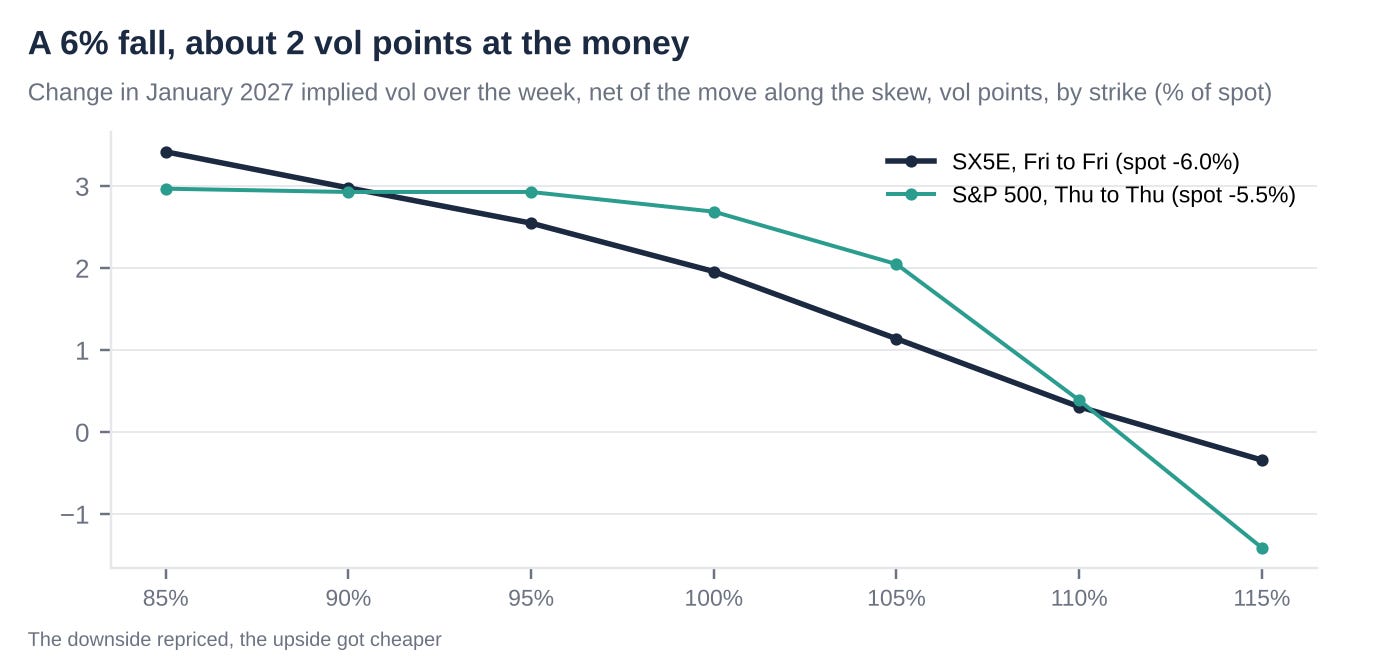
Options did less than the price action suggests. Net of the move along the skew (strikes getting closer to the money as the index falls), SX5E January options rose only 2.0 vol points at the money on a 6.0% weekly fall, 3.0 at the 90% strike and 3.4 at 85%, while the 110% and 115% strikes barely moved or fell.
In the S&P 500, Thursday to Thursday on a 5.5% fall, January ATM rose 2.7 points and the 90% strike 2.9, while the 115% strike fell 1.4. December 2027 options moved 0.3 to 0.4 points in both indices, so the repricing sits in the next two months and in the downside… stress, not a new normal.
Term structures are inverted in both regions, with S&P 500 ATM vol going from 31.8 at one month to 22.2 at one year at Thursday’s close, and European downside protection is the most expensive relative to the US in a year.
Last week we wrote that front vols underpriced the potential for moves. Monday’s 1.9% fall bore it out, options had caught up by Wednesday and on Thursday we dropped the view. At Thursday’s close the 1m ATM straddle priced 7.2% in the S&P 500 and 5.0% in the SX5E, about 1.6% and 1.1% either way on an average day, against our forecast of about 1.2% for the S&P 500 after Friday and roughly 1.0% on the average Fed, CPI or payrolls day of the past four years. Options charge for the turbulence continuing, not for a crash.
Nvidia & AI
Nvidia fell 22.9% on the week to $125.53 on legal and governance questions rather than demand, as the SEC probe into its disclosures widened, according to Reuters, to potential accounting issues, and Bessent gave the board ten days to answer. The interim CEO had just raised the growth outlook for the year to January 2028 to about 75% from 70%.
At about 7.5x forward earnings the stock prices a lot of that, but accounting questions are a different risk from the key-man risk the market was pricing a week ago, and the board’s answers are the next test.
The rest of the chain fell with it, the money leaving the theme rather than rotating inside it. In the week to Thursday the chip designers (GPUs and custom chips) fell about 20% to 11.5x forward earnings, memory 15% to about 3x, foundry and chip equipment 18% to 17x and optical networking 16% to 23.5x, while the grid names lost 10% (21x) and the platforms 7% (23x).
The neoclouds that rent out AI compute on debt lost 20%, with Oracle at 11.8x, and they remain the weakest link. Demand still points up, with BABA’s quarterly capex up 60% to about $7.5bn partly on higher chip prices… the selling is about who funds this and how much risk holders can carry, and Anthropic giving back 8.5% on Friday, its second day of trading, did not help.
Dollar & gold
DXY rose 0.4% to 103.8 after a 19-month high on Thursday, and the yen sits near 159 per dollar, just short of the 160 it touched last week. Gold fell 8.9% to $3,539, 3.7% of it on Friday, a 14-month low, with silver down 7.4% on Friday alone.
Two of the signals we watch for gold’s turn moved our way this week: the priced Fed path stopped rising and turned down while officials talked tougher, and real yields rolled over from their one-year high. Gold fell anyway, which is funds selling what they can sell for cash rather than a verdict on rates. Gold rising on a day equities fall would tell us that selling is over.
Korea & China
The KOSPI fell about 8% on the week and EWY 13.7% to $123.26, 8.4% of it on Friday in New York after Seoul had already closed down 5.2%. Samsung and SK hynix lost about 10% each, foreigners sold about $1bn on Monday and $1bn on Tuesday while local retail bought, and the won traded around 1,338 per dollar.
The two memory makers trade at 2–3x forward earnings, a price for the end of the cycle that BABA’s capex and Nvidia’s raised outlook contradict… the seller is foreign de-grossing, not a change in memory demand.
China fell less but without support. The CSI 300 hit a 17-month low on Friday, the PBoC left its lending rates unchanged and drained a net $58bn in its daily operations at the end of the week, and the Trump–Xi–Putin meeting in Shenzhen produced statements rather than deliverables, with the trade truce still expiring on 10 January. China needs the central bank to expand its balance sheet, and it is doing the opposite.
What would turn it
The selling has the marks of forced liquidation, and the base rates favour a bounce. What makes it last is a different question.
1.) The Fed’s last word before the blackout. Officials go quiet on Saturday 28 November ahead of the 9 December decision, starting with Williams on Monday (21:00 London), who said on Tuesday the situation does not call for “dramatic action”. Wednesday’s October PCE (13:30 London) is expected at 0.3% for the core: a 0.2% would take the air out of 50bp, a 0.4% would put it back on the table.
2.) Bonds have already voted. Thirty basis points out of September 2027 in a week, real yields off a 24-year high at auction and the 2-year down 19.5bp while officials talked tougher. Equities follow bonds once the Fed’s leadership accepts what the futures price, and Monday’s $69bn 2-year auction (18:00 London) is the first test of that bid.
3.) The marks of a flush. Seven straight losses, $11.7bn out of SPY on Friday, stocks moving together as they do when funds sell everything, gold and silver sold with equities, and one-month index protection costing about 16% more than three-month, the steepest inversion since April 2025.
The four previous times since 2024 that the inversion went past 10% (August 2024, December 2024, April 2025 and 5 November this year), the S&P 500 was higher a week later every time, by 2.8% to 5.7%. But the last of those bounced 3% and then gave it all back this week. In 2022 rallies kept failing while the Fed kept hiking into weakness, and in April 2025 the policy that caused the fall reversed and the low held. This time the policy that has to bend is the Fed’s.
4.) Headlines that could land in days. Nvidia’s board answers to the Treasury, due around Thanksgiving. In the Gulf, Iran turned up the pressure over the weekend: on Saturday two tanker attacks were reported off Khasab, at the mouth of the Strait of Hormuz, Iran said a tanker hit a mine in a restricted zone, and an Iranian attack set fire to a civilian industrial site in Bahrain. According to CBS, US forces could strike within two to four days of an order, but Trump said on Thursday he is “not rushing into any decision” and will see “what happens after the beginning of the year”… so for now the escalation comes from Tehran, and Monday’s oil open is the first read. Oil higher is the one thing that would rescue the hawks. Any follow-up on Trump’s threat of “tremendous” penalties for US companies building data centres abroad.
5.) The tells we watch. Gold rising on a down day for equities. EWY at Monday’s Seoul open against Friday’s 8.4% drop in New York. The Bloomberg US high-yield spread (the extra yield junk bonds pay over Treasuries), 344bp on Thursday near our 350bp marker, and whether it moves with the neoclouds.
Risk
The clearest disagreement this week is in rates, not equities. Futures still price the September 2027 policy rate at 4.47%, about 43bp above the December contract, and we think the economy will not need the hikes after December the hawks are talking about. That view is wrong if core PCE prints 0.4% or more, if oil spikes on Iran, or if the December statement signals a hike at every meeting.
On equities we stay cautious until one of the keys above turns, the Fed first.
The week ahead
Monday brings Korea’s exports for the first 20 days of November, the flash PMIs (US 14:45 London), the $69bn 2-year auction (18:00) and Williams (21:00), with Japan on holiday. Tuesday has Conference Board confidence (15:00) and the 5-year auction (18:00). Wednesday is the heavy day: October PCE and the second estimate of Q3 GDP (both 13:30, GDP first printed at 3.4%), durable goods, jobless claims brought forward, the 7-year auction (18:00) and the Beige Book.
US markets close on Thursday for Thanksgiving, when the Bank of Korea decides (a 25bp hike to 3.25% is expected), the ECB publishes its minutes and the BoE its Financial Stability Report. Friday is a half day in New York (stocks close at 18:00 London) with China’s industrial profits. The Fed’s blackout starts on Saturday, OPEC+ meets on Sunday 29 November, and the Treasury’s next buyback, up to $6bn of 10–20-year bonds, is on 2 December.
Thanks for reading Macro Derivs. If this was useful, forward it to a colleague and subscribe to get the weekly wrap every Sunday morning.
Macro Derivs is general market commentary for information and education only. It is not investment advice or an investment recommendation, and it takes no account of any reader’s circumstances. Views are the author’s own and can change without notice. The author works in financial markets and may hold positions in the instruments discussed.