

State curbs and cautious buyers hit AI hardware; equal weight and Europe held up.

IN SHORT
• The S&P 500 fell 2.7% and the Nasdaq 100 5.0% as state curbs on data centres and cautious buyers hit AI hardware; the equal-weight S&P 500 lost only 1.0%.
• Memory makers fell 20% in the week to 3.1 times forward earnings while the hyperscalers gained 1.8%; in our view the global chip suppliers were punished too hard.
• Credit strain showed up at the neoclouds, but the Bloomberg US high-yield spread ended the week at 336bp, about where it started.
• The KOSPI lost 11.7% in the week; Samsung and SK hynix trade on about 2.5 times forward earnings and we stay constructive.
Markets
The S&P 500 fell 2.7% to 7,377, its worst week since June, and the Nasdaq 100 lost 5.0%, while the equal-weight S&P 500 slipped only 1.0% and the Euro Stoxx 50 gained 0.6% to 6,170. A Democratic sweep of Congress and a wave of governors promising to curb data centres turned Thursday into the worst day for chip stocks since March 2020, and the VIX ended the week at 25.6, up from 19.4. Last week’s main call held, with equal weight close to four points ahead of the Nasdaq 100 since 30 October; our view on credit fared worse.
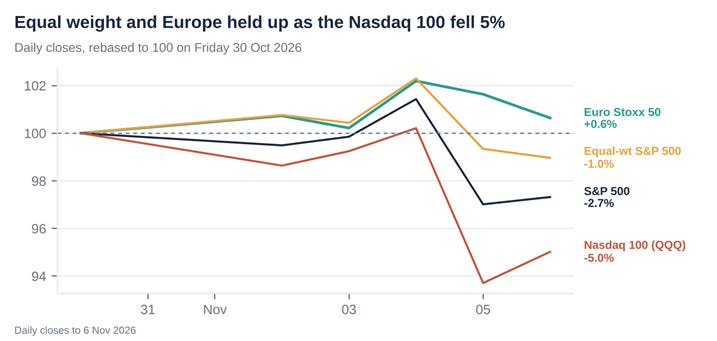
S&P 500, Nasdaq 100 (QQQ), equal-weight S&P 500 (RSP) and Euro Stoxx 50 since 30 October, rebased to 100
Power politics
Democrats won both chambers on Tuesday, but the votes that moved markets were cast for governors. What turned an election into Thursday’s 12% fall in the chip index? Three things.
1.) The states. Texas, home to about a quarter of the data-centre capacity planned in the US, elected a governor who pledged a moratorium on new approvals; Georgia’s governor-elect promised a pause and Ohio’s a moratorium unless developers pay their own power and water costs. States likely to tighten hold about 45% of planned US capacity, although only 12 of the 34 governors elected in called races back outright bans, against 32 who want tighter rules, according to Data Center Watch.
2.) Washington. A federal ban cannot get past a presidential veto, but a House bill asking states to make campuses of 100MW or more pay their full grid costs passed 417 to 3 in September, and the Democrats who blocked it in the Senate as too weak will now run that chamber. That simply raises the cost of the build rather than stopping it in our opinion.
3.) The buyers. On Wednesday OpenAI was said to be discussing whether to reset their 2027 capacity plans, according to the WSJ; Meta’s president said new US builds “will be very challenging” and that Meta (17x forward earnings) may build overseas; and Microsoft (26x) is reported to be renting less capacity from the neoclouds. That is what turned a political scare into a question about 2027 orders.
In our opinion the data centres still get built, but later, elsewhere and at a higher price, with the grid bill moving from households to developers. Should be a timing shock for the chip suppliers and a cost shock for the builders, which on Thursday the market seem to have priced as one.
AI stack
Memory makers, whose chips feed the processors, fell 20% in the week and trade on 3.1 times forward earnings…..market is pricing end of cycle here while analysts are forecasting peak earnings in 2029/2030. Foundries and chip-equipment makers lost 10% (19.5x), GPU and custom-chip designers 10% (16.8x, with Nvidia on 15.4x against 24.2x for the platforms that buy its chips) and optics and networking makers, which move data between chips and are paid as buildings go live, 9% (25x). The neoclouds that rent out computing power on borrowed money fell 11% and the grid and electrical-equipment makers 8.5% (22x). The hyperscalers gained 1.8% on hopes that slower building means more free cash flow, and data-centre owners, valued on cash flow at about 58 times earnings, lost only 1.5%, as scarce permits raise the value of what is already built. In our view the market has the builders and the power chain about right and has punished the global suppliers too hard, since their chips are made in Taiwan and Korea for buyers everywhere, and a project blocked in one state can move to another or abroad. We said so on Thursday morning and were early, as memory and equipment lost another 11–18% that day. Friday’s rebound, with AMD up 11% and TSMC 6%, was a start, but low multiples alone will not finish the job until a buyer confirms its 2027 volumes.
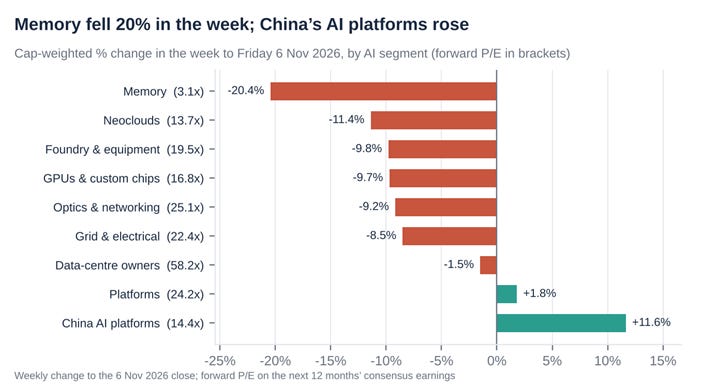
Weekly change by AI segment, with forward P/E
Neoclouds
CoreWeave’s 2031 bonds traded near 80 cents on the dollar this week and the cost of insuring its debt against default hit a record. Also an unnamed seller put $500m of data-centre loans up for auction. Last week we argued that the bill for AI was landing on shareholders rather than lenders; at the most leveraged borrowers that no longer holds, and there we were wrong. The index has not followed: the Bloomberg US high-yield spread, the extra yield junk bonds pay over Treasuries, ended the week at 336bp, about where it started, and Meta’s first euro bond, about $10bn, drew record orders of around $60bn. Lenders are separating the platforms, which can pay, from the neoclouds (13.7 times forward earnings for the profitable ones), which need a handful of customers to keep renting. CoreWeave’s results on Tuesday will test where that line sits.
Positioning
The size of Thursday’s fall owed as much to who was selling as to the news. Hedge funds were already underweight AI after dumping about $20bn of tech in the fortnight before, so the sellers were retail investors, whose net selling ranked behind only two sessions of March 2020 according to Vanda Research, and rules-based funds cutting exposure as volatility jumped. Options are pricing a bumpier market, not a crash: a 1-month at-the-money S&P 500 straddle implies a 1.27% daily move against 1.24% realised over the past month, but the VIX sits above its 3-month equivalent (25.6 against 24.6), and SPX 3-month 90/100 skew, reached 7.7 vol points on Thursday, the highest of the past year. Implied correlation, how much options assume stocks move together, jumped from the bottom 13% of five years to mid-range in a day.
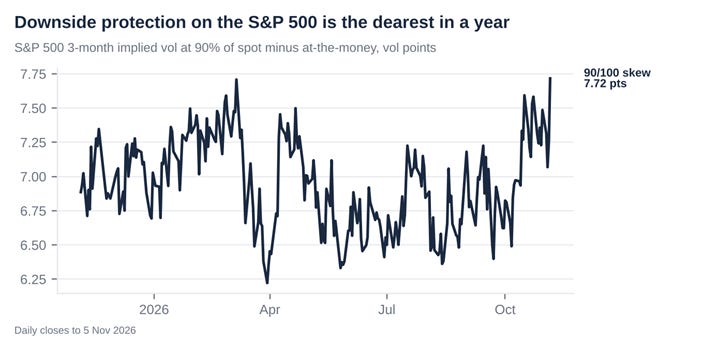
S&P 500 3-month 90/100 skew over the past year
Korea & China
The KOSPI lost 11.7% in the week with a circuit breaker on Friday after an 8.6% drop, as foreigners sold about $2.0bn that day and the won weakened to 1,357 per USD. EWY fell 10.4% and is still up 41% this year. Yet Samsung and SK hynix, 44% of EWY, sell memory into global demand, SK hynix has more than half of its 2027–28 capacity under contract, and the two trade on about 2.5 times forward earnings, a price that already assumes the cycle has peaked. Contract prices for 2027 are the number to watch, and we stay constructive. China gained from the same politics. The CSI 300 jumped 2.3% on Wednesday after the PBoC said banks had applied for about $30bn of its buyback loans, and China’s AI platforms, on about 14 times forward earnings, gained 12% on hopes that a divided Washington eases trade tension. Support still targets share prices rather than household spending; until that changes we expect China to lag.
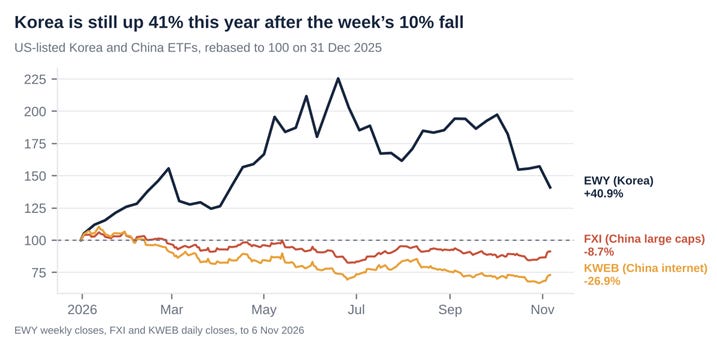
EWY, FXI and KWEB this year, rebased to 100
Rates
Treasuries rallied through the sell-off. The 2-year Treasury yield fell 5bp in the week to 4.51% and the 10-year 8bp to 4.86%, all of it in breakevens, the inflation rate bonds are pricing, down 10bp to 2.24% as Brent fell to $98 from about $113 on bets that a Democratic Congress and Qatar’s mediation end the Iran war. Then October payrolls rose 165,000 against about 60,000 expected, and the odds of a December Fed hike went back to about three in four, from two-thirds after Thursday. With oil below the $110 we said was holding up a hike, we see a December move as a mistake, and Tuesday’s CPI probably decides whether the Fed makes it. The refunding, when the Treasury sets how much it borrows and in which maturities, proved us wrong: it left auction sizes unchanged BUT nearly doubled its buybacks of older bonds, to up to $70bn this quarter (vs $38B in August), instead of selling fewer long ones. The 30-year now yields 40bp more than the 10-year, against 34bp when we expected that gap to narrow.
Liquidity
The relief we said had to come from the Treasury has started. In the week to Wednesday 4 November it ran down its cash account at the Fed, the TGA, by $79bn to $936bn, lifting bank reserves $68bn to $2.96tn, while the Fed itself added only $2.5bn to its balance sheet. Cash is not plentiful yet: reserves are below $3tn and SOFR, the overnight rate on loans backed by Treasuries, still fixes 2bp above the rate the Fed pays on reserves. Gold read the change, up 5% in the week to about $4,070 as selling by funds raising cash faded, while China’s central bank added about 26 tonnes in October, its 24th month of buying, into the slide. In our opinion the official buyer is replacing the forced seller but we reiterated that to see a more significant move we want to see the PBOC expanding its balance sheet.
Risk
The scarce input in AI was chips, then from October it was money; this week it became permission, and that changes who gets paid. We keep the first half of our thesis, that demand is clear, and widen the second, that the price of capital sets the direction: capital, power and permits are now all prices the build has to pay, and they fall on the builders (neoclouds, grid installers, US power developers) far more than on the platforms or the global chip suppliers. The bears read OpenAI’s reset as the first admission that 2027 was overbuilt; the bulls might say compute relocates rather than disappears. The parallel we take seriously is US nuclear power in the 1970s: once local opposition and rising costs set in, almost every reactor ordered after 1973 was later cancelled, the builders and their lenders suffered, and the plants already running became more valuable. We think this rhymes, with standing powered capacity gaining, new US builds slowing and chip suppliers losing time rather than demand. What settles it is whether any platform trims its 2027 budget, with Nvidia’s results on 17 November the first read, and whether the Bloomberg US high-yield spread breaks 350bp.
The scarce input in AI was chips, then from October it was money; this week it became permission, and that changes who gets paid.
The week ahead
China’s October inflation data arrive on Monday (01:30 London), and the Treasury sells $125bn of 3-, 10- and 30-year debt on Monday, Tuesday and Thursday (18:00 London each). Tuesday brings US October CPI (13:30, 0.3% expected on the month, 0.2% core) and CoreWeave’s results after the US close; the US bond market is shut on Wednesday for Veterans Day. Thursday has UK third-quarter GDP (07:00) and results from Applied Materials and Cisco, and Friday US producer prices (13:30), ahead of Nvidia’s results on 17 November.
Thanks for reading Macro Derivs. If this was useful, forward it to a colleague and subscribe to get the weekly wrap every Sunday morning.
Macro Derivs is general market commentary for information and education only. It is not investment advice or an investment recommendation, and it takes no account of any reader’s circumstances. Views are the author’s own and can change without notice. The author works in financial markets and may hold positions in the instruments discussed.