Global Financial Markets: Weekly Summary (May 12 - May 16, 2025)
I. Weekly Market Overview
The week of May 12-16, 2025 we witnessed a significant rally in global equity markets, largely propelled by the weekend announcement of a temporary de-escalation in U.S.-China trade tensions. This optimism was further fueled as U.S. inflation data for April came in milder than anticipated, raising hopes for a more accommodative monetary policy stance from the Federal Reserve. However, the week was not without its complexities; mixed signals from U.S. retail sales, which indicated a marked slowdown in consumer spending, and a UK Q1 GDP figure that, while robust on the surface, contained underlying nuances, introduced elements of caution. The US dollar exhibited modest strength over the week while commodities presented a varied performance, with crude oil prices gaining while gold and natural gas declined. Cryptocurrencies also displayed a mixed picture, not entirely mirroring the bullish sentiment observed in traditional equity markets. They bottomed out before equities, perhaps they are topping out before? We don’t think so, but many people surely will. This said, SPX comes from rallying 23% from the bottom and very seldom times we can observe big indices propagating in straight line for extended periods of time. For this we think it might consolidate and perhaps have a 1-3% pullback next week ahead of a renewed rally. Also to potential to trigger a storm in the horizon remain the long-term trade issues which remain unresolved and even if we believe in Trump’s rationality, we don’t think negotiations will sail on straight line either and yields too high.
This said, we remain bullish medium term. We don’t believe, as most commentators, that late market’s pronounced positive reaction is exclusively due to trade negotiations. Other important factors were in our opinion the extreme bearish positioning by the Asset Manager community and CTA’s and HFs having to short cover as markets rallied. There have been 1T/year of buybacks by SPX companies (with a record $665B announced only last Quarter) since 2021 with record low number of IPOs since then to compensate (they act as liquidity drainage). FED & ECB have reduced their balance sheet since the end of 2022 but they have stopped now, and they are 4.5T higher than they were in 2020…. because of a flu…And many other Asian CBshave been, at the very least stable, if not expanding their balance sheets significantly, like PBOC. And that’s not to speak of the fiscal spending which has been increased almost in every country and a big chunk of it is monetized by their local bank.
We know all this cannot continue. There are big consequences we can already see and bigger ones on the horizon. The goal of this back of the envelope calculations is however to just say, that short term, we don’t think overall positioning is too long and deserves correction. Trader’s positioning will move from long to short more often creating the short term pull backs and rallies, but the core positioning of stickier money investors is not long in our opinion. We still think it is on the underweight side despite some bubbles forming occasionally in some areas.
As we mentioned in our last writing, the key for the extension of the rally assuming trade negotiations will go reasonably well, will lie on the yields. We won’t enter on how we believe the mechanics of these operate, but where everyone agrees on, is that long term yields are key for the valuation of asset classes. We think the Trump administration is focused on it and will get even more focused in bringing these down. CPI reading this week showed cooler-than-expected inflation, with headline CPI up 2.3% and core up 2.8% over the last 12 months with consumer energy prices down nearly 4% YoY. We are of the view (and this is far from consensus) that the Fed is currently too restrictive given that inflation is now lower than it was in September (and they made an emergency 50 basis point cut) but more importantly, putting into the context of the amount of debt and refinancing needs there are this year, something will need to be done. Bessent has been talking repeatedly about bringing the long end of the curve down as crucial for housing and refinancing debt. He is now talking about SLR (Supplemental Leverage Ratio) which is in the end deregulating banks so they can buy this part of the curve instead of just the front end. Also, we would not be surprised if Trump, on his last trip to Middle East, has been trying to include some Treasuries sell in his multi trillion USD investment deals.
All in all, we are of the view that 10y will fall below 4% and this will allow SPX break through comfortably the ATH. Should we be wrong and yields stay sticky or even rise, we see stock market capped not far from where we currently are. Let’s see…
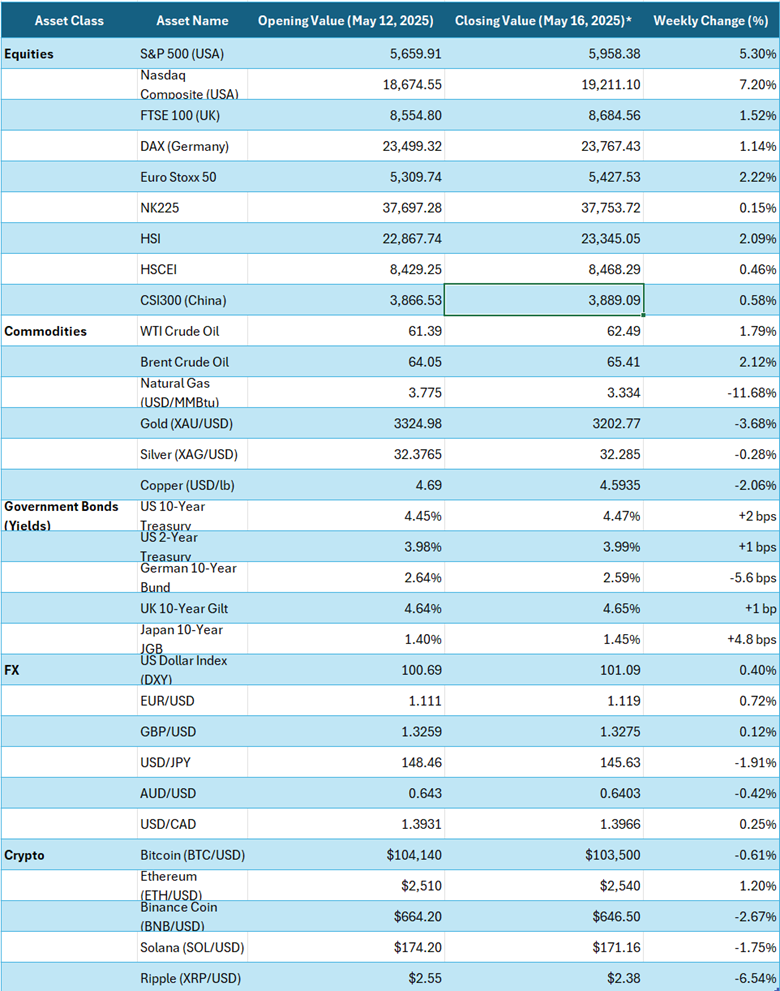
Below the usual markets weekly performance table and below a bit of an in-depth analysis of the semiconductor sector which we believe will be at the forefront of market narratives in the months and years to come.
II. Semiconductor Sector Analysis
We wanted to analyze this sector a bit deeper for some time and we wish we had published this piece a bit earlier considering the big rally it’s had had since the beginning of April 😊 (and this week alone +10%). We did mentioned Semis as our favorite sector in our note last week when we had started this research and we have bullish on it for some time. Recent Semis performance: Since beginning of April +16% vs SPX +4%. Even beta adjusting by 2.5 is still a significant outperformance.
One reason for the delay was we wanted enough of the sector to have published earnings to be more relevant in getting the big picture. At no time anyway, this pretends to turn into short term trading advice. The goal is to bring up some interesting thoughts and knowledge for people to make their own calls. We also think the sector has so much upside potential that last week’s rally still leaves room to produce substantial returns on it. At the same time, we chose not to wait for Nvidia to report as even though it’s the most significant company in the sector, it reports one of the last on SPX (28th May) and we can pretty much infer the outcome from the other companies in the sector. The things below in which we refer to Nvidia however come from previous earnings calls or comments made public during the quarter.
For clarity regarding the characteristics and limitations of the analysis, we want to highlight it has been conducted using the transcripts from the earnings calls the companies have published. When we speak about the ‘tone’ of the CEO we refer to the tone we can infer from the transcript rather than us listening to the call itself. Perhaps that would make it a bit more accurate, but we are not sure it would be worth the extra time needed to analyze that way. Lastly, we want to mention we are not experts in the sector. We only pretend to share some ideas and analysis based on what the companies say themselves in the sector. As Druckenmiller mentions often: ‘Markets price things so fast nowadays that if you have a idea, it often pays to act quickly on it, then do the detailed research on it’. We will also attempt to navigate that thin line between giving enough details that make it interesting, and value added while avoiding making it too boringly detailed. With this said, we dive into it.
Near-Term Semiconductor Demand: Insights from Q1 & Q2 2025 Earnings Calls
1. Overview: AI Dominates a Shifting Semiconductor Landscape
The semiconductor market, as we look forward to the next couple of quarters in 2025, has 2 differentiated angles in our opinion. Artificial Intelligence (AI) is firmly in the spotlight while most of the rest of the semiconductors businesses are sailing through their usual business cycles. Insights from the latest earnings calls of key U.S. technology and semiconductor companies paints a clear a picture in what it refers to surging demand for AI-related components. These are mainly: 1) high-performance GPUs, 2) custom AI accelerators, 3) High-Bandwidth Memory (HBM) as data centers continue their aggressive build-out. This AI-driven boom is clearly continuously highlighted vs the more measured recovery seen in traditional semiconductor segments like PCs and other industrial segments. Geopolitical factors, particularly tariffs and export controls are also mentioned repeatedly on the earnings calls.
The market segments coming from management discussions could be broken down as:
AI is the primary demand catalyst: Continuous mentioning of the strong data center demand reported by hyperscalers (sorry fancy word, seems we’ll all have to get used to it 😊) like Google , Microsoft , and Amazon, who are all making massive investments in AI infrastructure. This is obviously the most interesting and bullish part, and we’ll give more details on it below.
PCs showing mixed signals: There's cautious optimism here, with potential boosts from AI PCs and Windows 10 end-of-life. CEOs are always going to talk about their product segments positively and give attractive market projections. We are skeptical of this sector and CEO’s sentiment feels less upbeat.
Automotive remains resilient: The trend of increasing chip content per vehicle continues to drive steady growth in this sector. We believe the running of this segment is capped as EV vehicles are the biggest source of demand for these and seems their demands is through its peak for most brands.
Industrial & IoT (internet of everything) seem to be recovering. According to some CEOs these markets are showing signs of improvement. We would not give a big weight to it, and we generally don’t buy their comments on it.
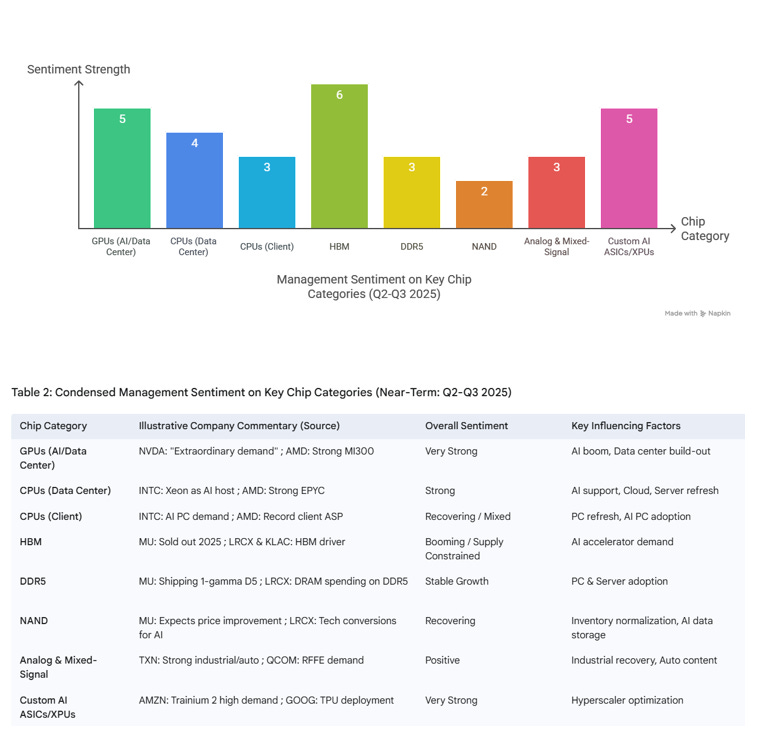
Another of the themes highlighted by most CEOs is the supply constraints they are experiencing on AI chips. Leading-edge AI chips are still hard to come by, while memory markets, especially HBM, are in increasingly high demand, with Micron noting its HBM is sold out for 2025. This AI group, the main market segment already accounting for 25-30% of the Company’s profits and growing at yearly rates of ~25%. This obviously is making most companies increase resources in this sector.
We find interesting the mentions that the focus on AI is creating a ripple effect. The demand for cutting-edge accelerators from Nvidia and AMD, and the resulting sell-out of HBM as Micron highlighted, is also pulling demand for related infrastructure like advanced networking solutions, where Broadcom is seeing strong AI networking demand. Even Intel noted hyperscalers (remember those are Google, Microsoft and Amazon) demand host CPUs for AI servers. Seems like even the not-top-notch GPU, the CPUs, are experiencing accelerated demand. Seems demand spurred by AI is not confined to the accelerator itself but extends to the entire system required to support these powerful processors.
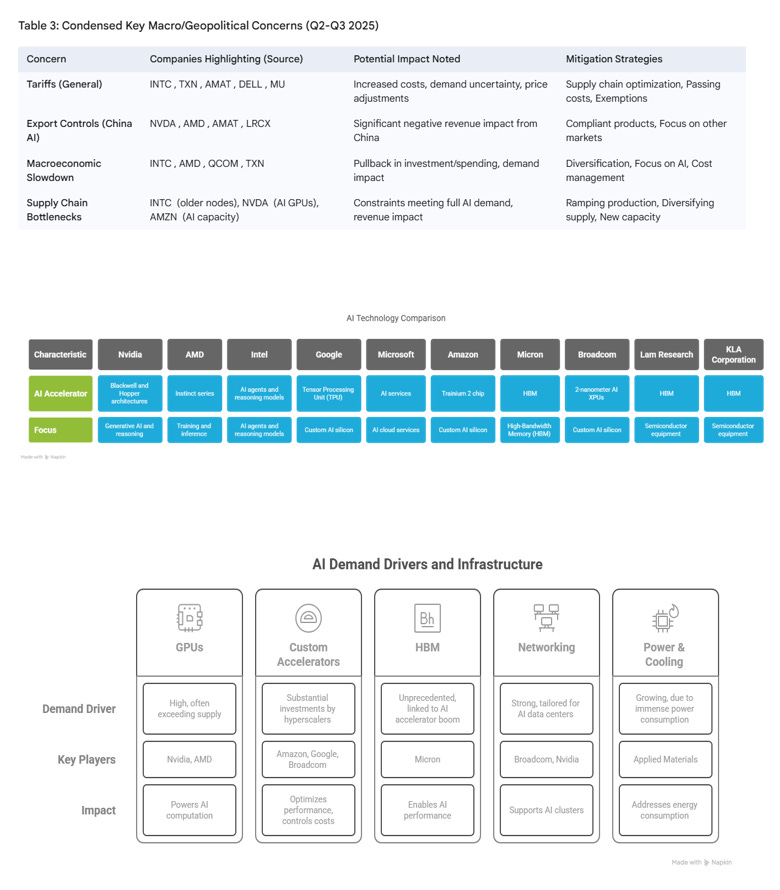
Furthermore, geopolitical tensions, frequently cited in earnings calls through discussions on tariffs and export controls, are evolving from being mere cost concerns to active influencers of strategic decision-making. Companies are increasingly emphasizing supply chain diversification and regional investment strategies. For instance, Texas Instruments highlighted the growing importance of "geopolitically dependable capacity" and its dual-flow manufacturing capabilities, while AMD noted the impact of new export license requirements on its sales to China. All this suggests to us, a long-term trend towards a semiconductor ecosystem that may be less globally optimized in terms of cost but potentially more resilient and secure.
To keep this writing’s length under control, we will explain in further detail our understanding of market direction and demand on the AI front, which is the backbone of the growth this sector is going to experience (and reason for our bullishness on the sector) while we will just go over quickly the other ones which we consider more stable, less significant and simply subject to the normal cyclicality of the sector.
2. AI Megatrend: The Engine of Chip Demand
Across the spectrum of semiconductor producers and major consumers like hyperscale cloud providers, management commentary consistently identifies Artificial Intelligence as the single most significant and pervasive demand driver. This influence seems to extend far beyond the initial phase of training large language models; it now encompasses inference workloads at scale (using trained models to make predictions, classifications and decision), the burgeoning field of on-device AI, and the integration of AI-powered features into a vast array of applications and services. Nvidia's management, for example, on previous earnings, had highlighted the evolution of AI beyond generative capabilities into "reasoning," which demands substantially more computational power and is finding its way into "virtually every consumer service". Similarly, AMD reported strong demand for its Instinct AI accelerators, catering to both training and inference needs. Intel is strategically focusing on AI agents and reasoning models, with the ambition of becoming a preferred platform for diverse AI workloads. This sentiment is strongly echoed by hyperscalers such as Google, Microsoft, and Amazon, all of whom are reporting massive investments in AI infrastructure and experiencing robust customer demand for AI cloud services. Microsoft, for instance, noted that AI services contributed a significant 16 percentage points to Azure's growth in its recent quarter.
GPUs, Custom Accelerators, and HBM: The AI Powerhouses
GPUs
The core of AI computation relies heavily on specialized processors. Demand for high-performance Graphics Processing Units (GPUs), such as Nvidia's Blackwell and Hopper architectures and AMD's Instinct series, is exceptionally strong, frequently outstripping available supply. Nvidia already characterized the demand for its upcoming Blackwell platform as "extraordinary," even before its broad market introduction in previous earnings.
Custom Accelerators
In parallel, hyperscaler cloud providers are making substantial investments in their own custom AI silicon, including Application-Specific Integrated Circuits (ASICs) and eXtreme Performance Units (XPUs). This strategy allows them to optimize performance for specific internal workloads and exert greater control over their technological roadmaps and cost structures. Amazon reported that demand for its Trainium 2 chip is currently exceeding its production capacity. Also, Google is actively deploying its seventh-generation Tensor Processing Unit (TPU), codenamed Ironwood, while also maintaining a strong partnership with Nvidia for GPU supply. Broadcom is also a key enabler in this space, currently taping out 2-nanometer AI XPUs for its hyperscaler partners.
High-Bandwidth Memory (HBM): Critical Enabler for AI Performance
The unprecedented demand for HBM is inextricably linked to the AI accelerator boom. As Micron's management noted, these high-performance chips are often "starved of memory bandwidth," making HBM indispensable. Micron reported that its HBM revenue grew by over 50% sequentially, surpassing $1 billion in the quarter, and that its HBM capacity is sold out for the entirety of calendar year 2025, with strong demand already visible for 2026. Semiconductor equipment manufacturers like Lam Research and KLA Corporation also identified HBM as a key driver for their respective businesses, underscoring the widespread impact of this memory technology.
AI's Ripple Effect on Infrastructure
The AI revolution is not solely about processors and memory; it necessitates a comprehensive upgrade of the supporting data center infrastructure.
Networking: AI clusters, often comprising tens of thousands of GPUs, require high-speed, low-latency networking fabrics to operate efficiently. Broadcom reported strong demand for its networking solutions tailored for AI data centers, with its AI-related revenue surging 77% year-over-year. Nvidia had also emphasized before the strong attachment rate of its networking solutions to its GPU compute systems.
Power Delivery & Cooling: While not always explicitly detailed in every earnings call, the immense power consumption of AI hardware implicitly signals a growing demand for advanced power management ICs and innovative cooling solutions. Applied Materials noted ongoing innovations in power electronics specifically aimed at addressing data center energy consumption challenges.
The AI boom is fostering a dynamic interplay where advancements in AI models create a demand for more powerful and specialized hardware. Nvidia's previous observation (lets see what they say in 2 weeks) that model capabilities are doubling in performance roughly every six months, with newer reasoning AI tasks potentially requiring 100 times more compute than previous generation tasks, exemplifies this. The availability of more potent hardware, in turn, empowers developers to create even more sophisticated AI applications, such as the agentic AI workflows mentioned by Microsoft. This creates in our opinion a self-reinforcing cycle, suggesting that the current surge in AI-related semiconductor demand is not a transient spike but rather the sustained change in the way we do things, with multi-year growth cycle driven by the co-evolution of software and hardware capabilities.
The increasing development of custom silicon by hyperscalers, while introducing a competitive dynamic for established merchant suppliers like Nvidia and AMD, also serves in our opinion as a powerful validation of the immense market opportunity in AI acceleration. The fact that companies like Amazon and Google are both investing heavily in their proprietary AI chips (Trainium and TPUs, respectively) while simultaneously remaining major consumers of Nvidia's GPUs and likely AMD's offerings, indicates that hyperscalers are often pursuing a dual strategy: leveraging merchant silicon for broad accessibility and leading-edge performance, while at the same time developing custom solutions tailored for specific, large-scale internal workloads where fine-tuned optimization can yield significant cost and performance advantages. This multifaceted approach ultimately expands the overall investment in AI silicon, potentially leading to a more fragmented but ultimately larger market for AI acceleration technologies.
Furthermore, the sheer scale of AI infrastructure deployments, exemplified by Nvidia's reference to customer projects involving clusters starting with 100,000 GPUs, has profound implications for the broader semiconductor manufacturing ecosystem. These leading-edge, complex GPUs and custom AI chips necessitate advanced Wafer Fab Equipment for their production (WFE refers to the highly specialized and sophisticated machinery used in the delicate process of semiconductor fabrication). Consequently, the robust end-demand for AI compute power translates directly into derived demand for the capital equipment supplied by companies such as Applied Materials, Lam Research, and KLA Corporation, signaling a healthy outlook for the WFE sector as it supports the AI-driven capacity expansion.
3. End-Market Demand: A Closer Look
Beyond the main AI trend, different end-markets have their own distinct demand stories.
Data Centers (General):
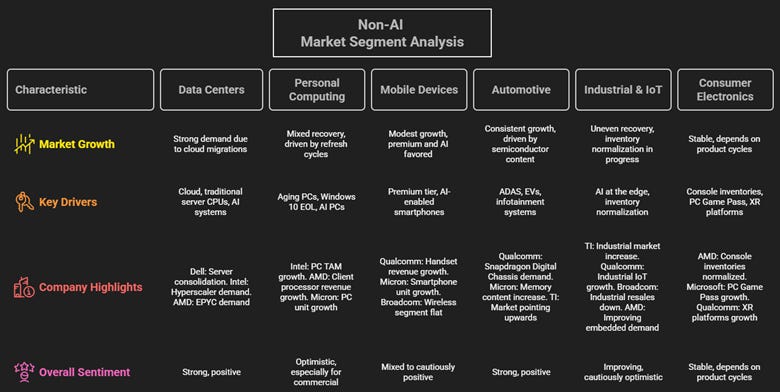
Demand for general data center infrastructure remains strong, driven by cloud migrations and the need for traditional server CPUs, which often support AI systems. Dell noted server consolidation as a key theme. Intel sees ongoing hyperscaler demand for its host CPUs for AI servers, and AMD reports strong demand for its EPYC server CPUs. Dell also mentioned double-digit growth in traditional server demand. The sentiment here remains strong and we buy that.
Personal Computing (PCs):
The PC market is mixed but shows signs of recovery according to CEOs. An aging installed base and the Windows 10 end-of-life in October 2025 are expected to drive a commercial refresh. AI PCs are also a significant factor. Intel projects PC TAM growth of 3-5%, noting stronger demand for older parts due to price sensitivity, alongside strong commercial demand for new AI PCs. AMD is confident in growing its client processor revenue significantly while Micron expects mid-single-digit PC unit growth, with AI PCs requiring more DRAM. Dell sees a PC recovery, especially in SMB (Small and medium size business) and commercial, though consumer demand is challenged. HP reported 10% year-over-year growth in commercial PC revenue, partly due to AI PCs…
All in all, the overall sentiment is optimistic, especially for the commercial sector. We don’t buy it.
Mobile Devices:
Modest overall unit growth is expected. Premium tier and AI-enabled smartphones are likely to do better. Qualcomm projects about 10% year-over-year revenue growth in its QCT handsets segment, driven by Android, especially in China's premium segment.Micron forecasts low single-digit growth in smartphone units, with AI driving increased mobile DRAM content. Broadcom noted its wireless segment was seasonally down but flat year-over-year.
All in all, Sentiment is mixed to cautiously positive. We don’t buy it
Automotive:
This market continues its consistent growth, fueled by increasing semiconductor content per vehicle (ADAS, EVs, infotainment). Qualcomm is seeing robust demand for its Snapdragon Digital Chassis, with automotive revenue up 59% year-over-year.Micron noted increasing memory and storage content per car. Texas Instruments observed the automotive market is pointing upwards again after a shallow correction.
All in all, sentiment is strong and positive. We are neutral. Nothing that isn’t priced in already in our opinion.
Industrial & IoT (Internet of things):
These markets are showing signs of recovery and inventory normalization, though it's uneven. Texas Instruments reported its industrial market segment increased by upper-single digits sequentially, calling it a "real recovery". Qualcomm is seeing strong growth in Industrial IoT, up 27% year-over-year, driven by AI at the edge. Broadcom, however, noted its industrial resales were down. AMD expects improving demand in its embedded segment in the second half of 2025.
Sentiment seems improving and cautiously optimistic. We have no view on it
Interesting Charts and Tables.
Lastly we wanted to include a few charts and tables that synthetize this non-friendly information for some 😊. We are aware this is always a difficult topic to follow as most of the things we are analyzing are things we ‘don’t see’ plus evolutions speed is mind blowing. Below here we will show in table and chart format some of the information already written in condensed format, plus some of the other interesting one that appeared on the earnings calls. Hope you enjoyed.