

Monthly Wrap — October 2026
Prices as of Tuesday 3 Nov 2026, 10:00 London (US closes as of Monday 2 Nov; October changes are from Wednesday 30 Sep to Friday 30 Oct closes)
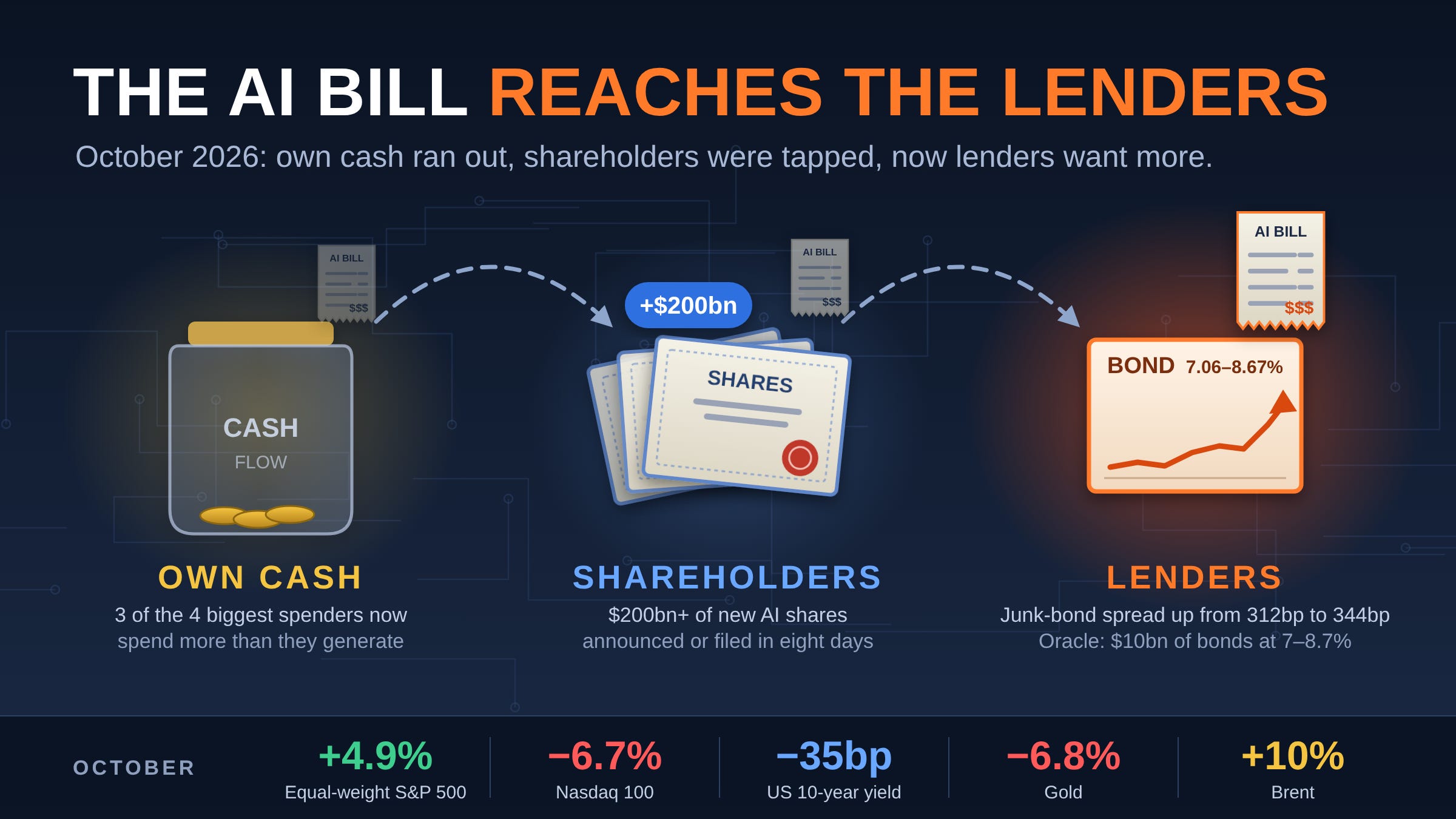
Markets: The S&P 500 ended October 0.9% lower at 7,580, three weeks after a record close of 7,819 on 6 October, but the equal-weight S&P 500 gained 4.9% while the Nasdaq 100 lost 6.7%, a gap of more than 11 points in a single month. The Euro Stoxx 50 fell 2.2% to 6,131 and the VIX rose to 19.4 from 16.3. Bonds took the other side of the equity selling, with the 10-year Treasury yield down about 35bp to 4.94%, its biggest monthly fall since December 2023, yet gold fell and oil rose, an odd mix for a month of falling yields. Through October we argued for a heavy index with wide dispersion underneath, and that is what the month delivered; AI hardware and gold are where we were wrong, and the first days of November have added a new element, with lenders now asking for a higher price as well.
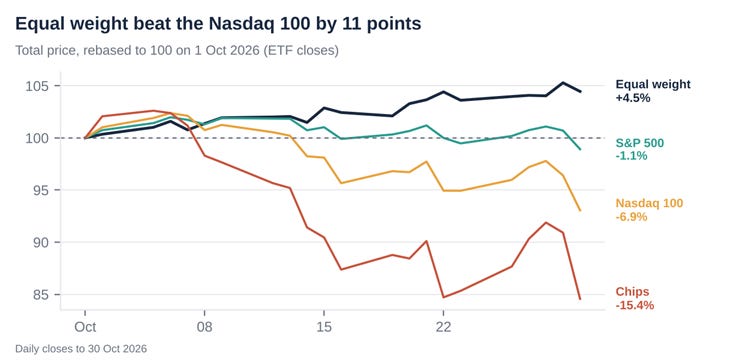
Chart 1: equal weight, the S&P 500, the Nasdaq 100 and chips through October
Scorecard: Since our 16 October wrap, when we expected equal weight and small caps to beat AI hardware while the index moved sideways, the equal-weight S&P 500 has beaten the Nasdaq 100 by almost 7 points, the central call of our October wraps. The view we set out that week, that bonds now trade the AI-spending question, also played out, with the 10-year yield 15bp lower by month-end as every scare about the build pulled yields down. On 23 October we said SK hynix’s and Samsung’s results would remind investors of the earnings rather than the financing worries; the KOSPI rose more than 8% into results day and still ended the month 3% above where it stood when we wrote it, although it has slipped since. China lagged, as we expected, for want of support for households. The misses were just as clear. On 16 October we thought chip stocks had priced most of the bad news; the chip index gained 6.9% in the four sessions to 29 October and then lost 7.2% on the 30th, and our claim that day that sellers of the scarcest input are insulated from their customers’ cash problems lasted one session. We expected the Fed to step up its purchases of Treasury bills (debt maturing within a year) before year-end, and it has not. We treated gold as a trade on real yields, the return after inflation, until late in the month; it is down 7% since mid-October while real yields fell. We also gave oil too much weight as the main support for a December hike: Brent is back below the $110 we named and the hike is still mostly priced. Two calls remain open and both resolve this month: a cut in long-bond supply at tomorrow’s refunding, when the Treasury sets how much it borrows and in which maturities, which dealers now expect, and the level of junk-bond spreads we named as confirmation of a credit squeeze, which is closer than at any time since we set it.
AI’s funding gap: Anthropic’s amended filing shows third-quarter revenue of about $17bn, twelve times a year earlier, cloud revenue at the three biggest platforms grew by close to 40% or more, and the memory makers are sold out for years, yet the Nasdaq 100 closed on Monday 10% below its peak. Demand gave no reason for October’s AI sell-off; what moved prices was the financing of the build in the years before that revenue covers it, and the market worked through the question in three steps.
1.) The biggest spenders ran through their own cash. Three of the four largest now spend more on data centres than their operations generate, their 2027 plans got bigger rather than smaller, and estimates published on Wall Street put hyperscaler borrowing next year above $400bn.
2.) Shareholders were asked to fill the gap. Meta’s raise of up to $97.5bn, Anthropic’s planned listing, reported at $100bn or more, and Oracle’s $10bn share sale, launched on Monday at about 11% below its last close, add up to more than $200bn of new AI equity announced or filed in the eight days to Monday.
3.) The marginal buyer stepped back. According to the FT, OpenAI cut its funding round to about $20bn from $30bn. The private labs spend other people’s money, which makes them the most elastic buyers of future chip capacity, and that is why the selling reached the suppliers in the last session of the month, when Intel fell 28.6% on a fourth-quarter guide it blamed on memory shortages.
The read-through is that the market now values each company in the AI chain by how it pays its share of the build rather than by the size of its order book. Anthropic has signed about $895bn of purchase commitments, roughly 13 years of its current revenue, so capacity is being paid for long before the revenue that justifies it shows up, and the price of that money has become the variable that sets the direction.
Lenders: The ICE BofA high-yield spread, the extra yield junk bonds pay over Treasuries, widened from 312bp at the end of September to 344bp at the end of October, 18bp of it on the last day, so lenders have started to ask for more as well. Oracle then priced $10bn of bonds at yields of 7.06% to 8.67%, 240bp to 335bp over Treasuries, and its five-year credit default swaps, the cost of insuring its debt, trade near 292bp. The tone had been building all month. Elon Musk said debt markets had “largely closed” to data-centre developers without revenue of their own, banks shelved a bond sale tied to an Anthropic-linked data centre in Texas after the state paused projects over grid risk, and US investment-grade issuance slowed to about $80bn in October, the lightest month of the year. Lending has become selective rather than closed, and in our experience that is how credit cycles start to turn. The next test is the price of Anthropic’s listing: an easy deal would say money is still plentiful for the strongest names, while a discount would say the squeeze has reached the companies that fill the suppliers’ order books.
Positioning: Hedge funds cut technology at the fastest pace in at least a decade in mid-October and, by the end of the month, had sold about $20bn in two weeks, wiping out their net AI buying since early 2025 and leaving them underweight AI for the first time since 2023, according to prime-brokerage data reported in the press. That explains the violence of the chip moves and suggests most of the forced selling is done, but on Monday’s close protection was still dearest where the damage was. Nasdaq 100 implied volatility of 30.9 sits in its 97th percentile of the past year, against the 68th for the Russell 2000, and S&P 500 3-month 90/100 skew, the extra cost of puts 10% below the market over at-the-money options, is 7.3 vol points, the 86th percentile. A 1-month at-the-money S&P 500 straddle prices 3.8%, implying a 1.06% daily move against 0.73% realised over 21 days, and November VIX futures trade above December, an event premium for the midterms, payrolls and Nvidia. Three-month implied correlation, a gauge of how much options assume stocks move together, has risen from the bottom 12% of five years in mid-October to the 32nd percentile, so the market is starting to price the risk that the AI unwind pulls the rest of the index down with it, the main threat to the equal-weight view.
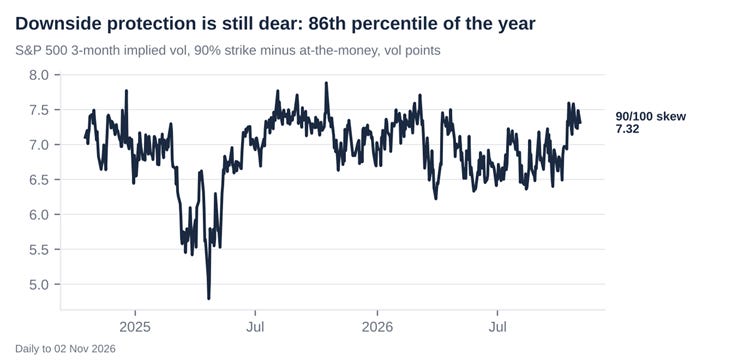
Chart 2: the extra cost of S&P 500 downside puts over two years
Korea & China: EWY lost 16.4% in October, trimming its gain this year to 57%, as the KOSPI slid from around 6,800 in the first week to 5,731 at month-end, first on mid-October reports that China’s CXMT is closing the gap in DRAM chips and then with the AI financing scare; foreign investors kept selling into November, about $1.1bn today as the index fell 3.6% to 5,649. The fundamentals went the other way. October chip exports reached $56.4bn, up 259% on the year, SK hynix reported a record quarter at an operating margin close to 80%, and both it and Samsung trade on about 3 times forward earnings. Apple’s warning last night that dearer memory will cut its gross margin to 45–46% from 47.9% shows who holds the pricing power, and the won has held near 1,341 per dollar. We remain constructive: the memory makers are the part of the AI chain that turns demand into cash. China fell for its own reasons. The CSI 300 dropped 8.5% in its worst month in a decade, as third-quarter growth of 4.5% lowered the odds of big stimulus and the official manufacturing PMI slipped to 49.3. Beijing has answered with support for share prices rather than households: about $19bn of state-linked buying of equity ETFs was reported in late October, and the PBoC cut the rate on its loans for share buybacks to 1% and offered banks up to about $150bn a day of overnight cash, while fixing the yuan weaker than expected, perhaps to slow its rise. FXI is down 14% this year and KWEB 33%. We expect China to lag until policy turns to household spending.
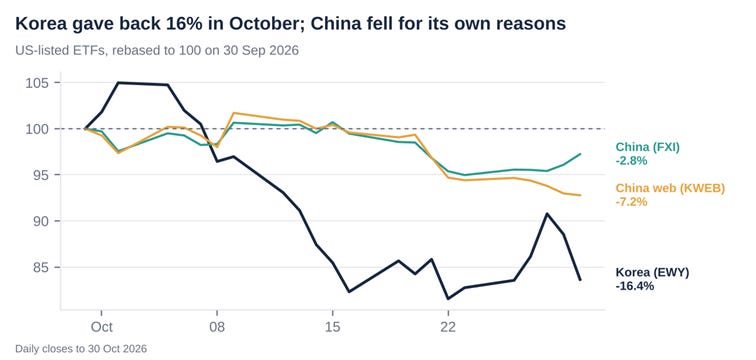
Chart 3: Korea and China through October
Rates: The 10-year Treasury yield touched 5.31% on 5 October, its highest since 2007, and the 30-year 5.72% two days later, its highest since 2002, before the money leaving AI hardware turned the rest of the month into a bond rally: the 30-year ended at 5.31% and the 2-year fell about 32bp to 4.56%. Real yields did about 85% of the work, the 10-year TIPS (inflation-protected Treasury) yield falling about 30bp to 2.60%, and the term premium, the extra yield investors demand to hold a long bond rather than roll short-term bills, fell about 20bp, so bonds priced slower growth and less long-dated supply rather than lower inflation. Demand was strongest at the long end: the 10-year auction on 7 October, at the top of the yield range, drew 80% from indirect bidders, the usual proxy for foreign demand, while the front end, where most new supply sits, needed concessions late in the month. Tomorrow’s refunding is expected to cut 20- and 30-year auction sizes and raise 2- to 7-year ones, and Monday’s estimates put borrowing at $618bn this quarter and $800bn in the next. That supports the long end near term, but it pushes more of a deficit of about $2tn, with gross interest at a record $1.36tn, into bills that banks and money funds pay for out of cash. Today’s midterms matter mainly through that channel: divided government, which prediction markets favour, would limit new fiscal stimulus, a help to the long end, at the cost of a funding fight before federal money runs out on 11 December.
Liquidity: That bill-heavy funding meets a banking system whose cash fell below $2.9tn in October. Bank reserves at the Fed peaked at $3.03tn in mid-October and fell about $136bn in the next two weeks to $2.895tn on 28 October, as the Treasury’s cash account at the Fed, the TGA, rose about $130bn to just over $1tn. SOFR, the overnight rate on loans backed by Treasuries, has fixed above the 3.90% the Fed pays on reserves every session since 23 October, a sign that cash is scarce, and the Fed is adding only about $4bn of bills a week after Warsh deferred any balance-sheet decision to early next year. The relief now comes from the Treasury, as we argued it had to: its plan to end December with $850bn of cash should hand about $165bn back to the banks over the next eight weeks. The window closes again in the first quarter, when it plans to rebuild its cash to $1tn by March. The global picture is easier but of lower quality. Global liquidity, the four big central banks’ balance sheets plus money supply in the US, euro area, Japan and China measured in dollars, is about $129tn, up some $8tn on a year ago, but the central banks together added almost nothing, close to a third of the rise is currency translation from a softer dollar vs CNH, and China’s money supply alone accounts for $6.8tn of it (money-supply data to 30 September, Fed data to 28 October). In our view that gives equities and gold a tailwind into December and a headwind again from January.
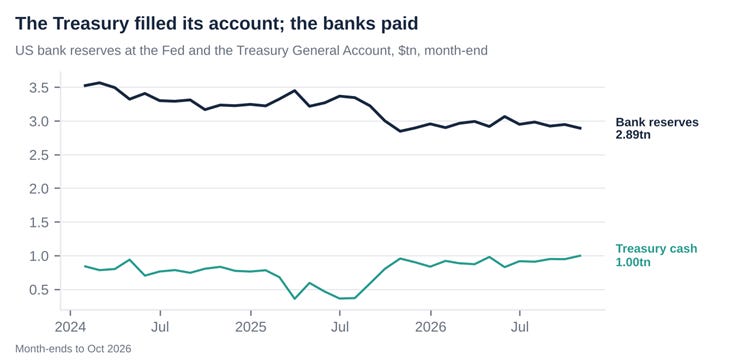
Chart 4: bank reserves and Treasury cash at month-ends since January 2024
Gold: Gold fell 6.8% in October to a one-year low of $3,875.84 on the last day and is down about 10% this year, although lower real yields and a flat dollar pointed the other way, which makes it the clearest casualty of scarce dollar cash. The selling came from investors raising cash: GLD had its largest weekly outflow since March in the week to 23 October, and hedge funds have cut their gold futures longs for nine straight weeks. Official buyers did the opposite, with China’s central bank adding gold for a 23rd month and World Gold Council data showing central banks buying at the fastest pace since 2024, so gold fell in the very month its most reliable buyers bought fastest. We read the slide as a funding event rather than a change in the long-term case, and it should fade as Treasury cash flows back to the banks; gold is around $3,909 this morning.
Policy: ISM manufacturing rose to 55.5 on Monday with its prices index at 75.2, and consumers’ 12-month inflation expectations reached 5.8% in the Conference Board survey, so strong data kept the Fed’s hawks in charge through the market’s swings. The Fed held at 3.75–4.00% on 28 October with two votes for a hike, Dallas Fed’s Logan has since called for “at least two more”, and a December hike is about 73% priced. Abroad the tightening continued: the RBA raised rates to 4.85% overnight, an 18-year high, sources point to an ECB hike in December, and the Bank of England is expected to hike on Thursday. Oil was the month’s other inflation lever. Brent rose about 10% in October, reaching $116.72 on 23 October, its highest since April, as attacks on Gulf shipping and Saudi facilities multiplied, then fell 7.6% on Monday to $104.77 on hopes for US–Iran talks and is back near $107 after a US strike on Iran’s Qeshm Island. December now turns on the jobs and inflation data more than on oil, and we still think a hike would be a mistake with real yields this high and funding this tight.
Europe: Europe held up better than US tech thanks to its small weight in AI hardware, and its own risk sat in the bond market. France’s 10-year yield reached 5.05% on 22 October, the highest since 2002, and its spread over Bunds peaked near 175bp, the widest since 2012, before easing to about 161bp after Moody’s kept its rating and Fitch moved only the outlook to negative; the budget deadline of 17 November is the next test. European options price more near-term stress than the US: the V2X, Europe’s volatility index, ended October at 22.1, almost three points above the VIX, with its November futures priced above December. We expect Europe to keep beating US tech while energy prices ease, with France the risk to watch.
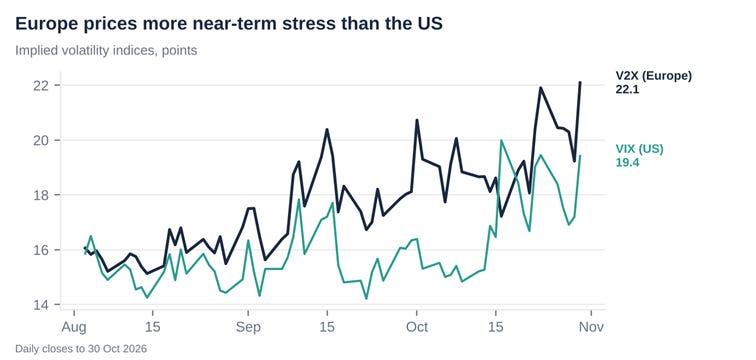
Chart 5: European and US implied volatility since August
Risk: Oracle’s raise on Monday, shares and bonds together, completed the shift we tracked all month, as the AI debate moved from the income statement to the cash-flow statement and is now reaching the balance sheet. Our running thesis is that demand is not the issue and the price of money sets the direction; on 30 October we narrowed it to a cost of capital rising through shareholders rather than lenders. Lenders are now joining in, just as a second borrower comes to the same table: after December’s relief, the Treasury funds its first-quarter borrowing largely with bills drawn from the same bank reserves. The bull case is strong and we share most of it, with AI revenue compounding faster than anyone forecast, suppliers sold out for years and most of the S&P 500 earning well. The bear case is about timing, since commitments that run years ahead of revenue must be financed at whatever price lenders set in early 2027. We have more conviction in the relative picture than in the index: cash generators keep beating cash burners, the long end is supported by the expected supply cuts while the front end pays, and the index churns. The high-yield spread through 350bp, or an Anthropic listing that needs a discount, would settle the debate for the bears.
Next month: Today’s US midterms produce first results from about midnight London. Wednesday brings the Treasury’s refunding (13:30 London) and ISM services (15:00), Thursday the Bank of England (12:00) and Friday October payrolls (13:30, about 65k expected). October CPI follows on Tuesday 10 November (13:30), in the week of the 3-, 10- and 30-year refunding auctions; Anthropic’s listing is expected in the week of 16 November, Nvidia reports on Tuesday 17 November after the US close (about 21:20 London) and France’s budget deadline falls the same day. The month closes with the run-up to the Fed’s 9 December decision (19:00 London) and the 11 December federal funding deadline.
Macro Derivs is general market commentary for information and education only. It is not investment advice or an investment recommendation, and it takes no account of any reader’s circumstances. Views are the author’s own and can change without notice. The author works in financial markets and may hold positions in the instruments discussed.